


Page 275 - Aerodynamics for Engineering Students
P. 275
258  Aerodynamics for Engineering Students


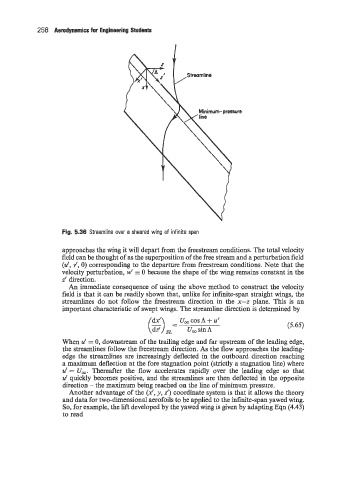
                                                        ,Streamline


                   Fig. 5.36  Streamline over a sheared wing of  infinite span


                   approaches the wing it will depart from the freestream conditions. The total velocity
                   field can be thought of as the superposition of the free stream and a perturbation field
                   (u', 6,O) corresponding to the departure from freestream conditions. Note that the
                   velocity perturbation,  w'  = 0 because the shape of the wing remains constant in the
                   z' direction.
                     An immediate consequence of using the above method to construct the velocity
                   field is that it can be readily shown that, unlike for infinite-span straight wings, the
                   streamlines do not  follow the  freestream direction in  the  x-z  plane.  This is  an
                   important characteristic of swept wings. The streamline direction is determined by

                                                      Urn cosA + ut
                                             (g)  U, sin A                            (5.65)
                                                  sL=
                   When ut = 0, downstream of the trailing edge and far upstream of the leading edge,
                    the streamlines follow the freestream direction. As the flow approaches the leading-
                    edge the streamlines are increasingly deflected in the outboard direction reaching
                    a maximum deflection at the fore stagnation point (strictly a stagnation line) where
                    u'  = U,.  Thereafter  the  flow  accelerates rapidly  over  the  leading edge  so  that
                    u'  quickly becomes positive, and the streamlines are then deflected in the opposite
                    direction - the maximum being reached on the line of minimum pressure.
                      Another advantage of the (2, y, 2) coordinate system is that it allows the theory
                    and data for two-dimensional aerofoils to be applied to the infinite-span yawed wing.
                    So, for example, the lift developed by the yawed wing is given by adapting Eqn (4.43)
                    to read

