


Page 419 - Air pollution and greenhouse gases from basic concepts to engineering applications for air emission control
P. 419
13.3  Properties of Nanoaerosol                                 399

            13.3 Properties of Nanoaerosol
            13.3.1 Number and Size of Nanoaerosol Particles


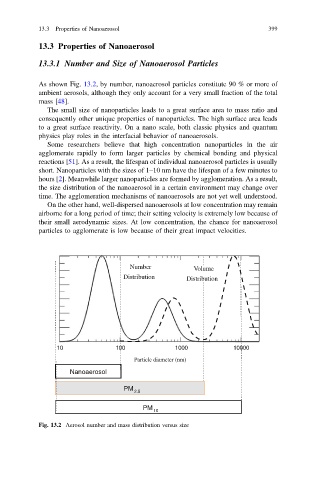
            As shown Fig. 13.2, by number, nanoaerosol particles constitute 90 % or more of
            ambient aerosols, although they only account for a very small fraction of the total
            mass [48].
              The small size of nanoparticles leads to a great surface area to mass ratio and
            consequently other unique properties of nanoparticles. The high surface area leads
            to a great surface reactivity. On a nano scale, both classic physics and quantum
            physics play roles in the interfacial behavior of nanoaerosols.
              Some researchers believe that high concentration nanoparticles in the air
            agglomerate rapidly to form larger particles by chemical bonding and physical
            reactions [51]. As a result, the lifespan of individual nanoaerosol particles is usually
            short. Nanoparticles with the sizes of 1–10 nm have the lifespan of a few minutes to
            hours [2]. Meanwhile larger nanoparticles are formed by agglomeration. As a result,
            the size distribution of the nanoaerosol in a certain environment may change over
            time. The agglomeration mechanisms of nanoaerosols are not yet well understood.
              On the other hand, well-dispersed nanoaerosols at low concentration may remain
            airborne for a long period of time; their setting velocity is extremely low because of
            their small aerodynamic sizes. At low concentration, the chance for nanoaerosol
            particles to agglomerate is low because of their great impact velocities.


                                     Number            Volume
                                   Distribution      Distribution


                 10              100              1000            10000
                                      Particle diameter (nm)
                    Nanoaerosol

                                   PM
                                      2.5
                                         PM
                                            10
            Fig. 13.2 Aerosol number and mass distribution versus size

