


Page 421 - Air pollution and greenhouse gases from basic concepts to engineering applications for air emission control
P. 421
13.3  Properties of Nanoaerosol                                 401

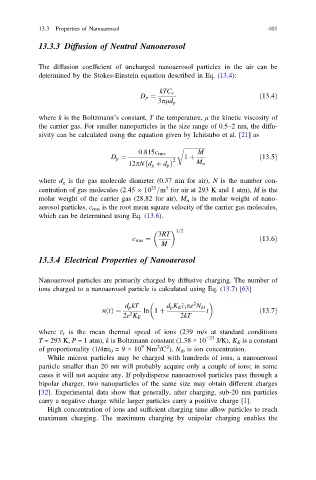
            13.3.3 Diffusion of Neutral Nanoaerosol

            The diffusion coefficient of uncharged nanoaerosol particles in the air can be
            determined by the Stokes-Einstein equation described in Eq. (13.4):

                                             kTC c
                                        D p ¼                            ð13:4Þ
                                             3pld p
            where k is the Boltzmann’s constant, T the temperature, μ the kinetic viscosity of
            the carrier gas. For smaller nanoparticles in the size range of 0.5–2 nm, the diffu-
            sivity can be calculated using the equation given by Ichitsubo et al. [21]as

                                                  r ffiffiffiffiffiffiffiffiffiffiffiffiffiffiffi
                                       0:815c rms       M
                                D p ¼               1 þ                  ð13:5Þ
                                                  2
                                     12pNd g þ d p      M n
            where d g is the gas molecule diameter (0.37 nm for air), N is the number con-
                                               3
                                           25
            centration of gas molecules (2:45   10 =m for air at 293 K and 1 atm), M is the
            molar weight of the carrier gas (28.82 for air), M n is the molar weight of nano-
            aerosol particles, c rms is the root mean square velocity of the carrier gas molecules,
            which can be determined using Eq. (13.6).

                                                  1=2
                                             3RT
                                      c rms ¼                            ð13:6Þ
                                              M
            13.3.4 Electrical Properties of Nanoaerosol


            Nanoaerosol particles are primarily charged by diffusive charging. The number of
            ions charged to a nanoaerosol particle is calculated using Eq. (13.7)[63]
                                                       2
                                    d p kT     d p K E c i pe N i0
                             nðtÞ¼       ln 1 þ           t              ð13:7Þ
                                     2
                                   2e K E          2kT
            where c i is the mean thermal speed of ions (239 m/s at standard conditions
            T = 293 K, P = 1 atm), k is Boltzmann constant (1.38 × 10 −23  J/K), K E is a constant
                                             2
                                               2
                                        9
            of proportionality (1/4πε 0 =9 × 10 Nm /C ), N i0 is ion concentration.
              While micron particles may be charged with hundreds of ions, a nanoaerosol
            particle smaller than 20 nm will probably acquire only a couple of ions; in some
            cases it will not acquire any. If polydisperse nanoaerosol particles pass through a
            bipolar charger, two nanoparticles of the same size may obtain different charges
            [32]. Experimental data show that generally, after charging, sub-20 nm particles
            carry a negative charge while larger particles carry a positive charge [1].
              High concentration of ions and sufficient charging time allow particles to reach
            maximum charging. The maximum charging by unipolar charging enables the

