


Page 418 - Air pollution and greenhouse gases from basic concepts to engineering applications for air emission control
P. 418
398                                                   13 Nanoaerosol

            or integumentary system and leach into the bloodstream. Contrary to neutral nano-
            aerosols of the same size; charged nanoaerosol particles have a much greater prob-
            ability of depositing into the lungs [9]. Similar to the effects of fine aerosol,
            nanoaerosol can cause inflammation, fibrosis, and lung tumors if the exposure at
            workplaces passes certain threshold and long-lasting. Increased surface area and
            decreased particle diameter are believed to be the cause of the increased toxicity of
            granular nanomaterials in the lungs. Lung toxicity, evidenced by inflammation and
            tissue damage, was also proven to be induced by fibrous nanomaterials such as carbon
            nanotubes (CNTs). Despite of the evidences provided by tests using rate, mice, and
            hamsters, not everybody agrees with the mechanisms of tumor development.
              Effects on the skin or a relevant skin penetration were not well quantified.
            However, the barrier function of the skin could be breached by the presence of skin
            lesions, strong mechanical strain or small-sized nanoparticles (<5–10 nm). For
            example, a human case of allergic response to nanomaterials was described by a
            person exposed to dendrimers in Japan [57]. A 22-year old student involved in
            synthesis of dendrimers developed erythema multiforme-like contact dermatitis on
            his hands. Conventional treatments and anti-histamines could not stop the disease
            from progressing to other areas of the body. After 3 weeks of hospitalization, he
            recovered, but it appeared again when he reentered the same laboratory.
              At this moment, there is no legal standard that sets the occupational exposure
            threshold of nanoaerosol. The development of risk assessment of exposure to
            nanoaerosol has been limited by the lack of standard methods and compact
            instrumentation for long term monitoring. Accurate risk assessment requires
            advanced nanoaerosol sampling and characterization techniques for the analysis of
            both physical and chemical properties of nanoaerosol. Nonetheless, occupational
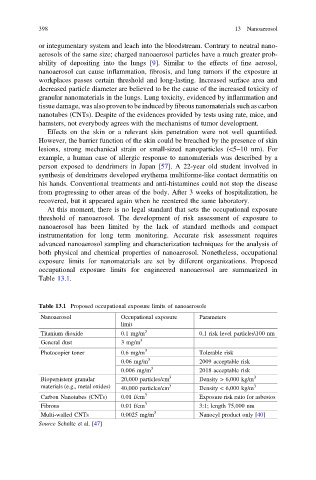
            exposure limits for nanomaterials are set by different organizations. Proposed
            occupational exposure limits for engineered nanoaerosol are summarized in
            Table 13.1.


            Table 13.1 Proposed occupational exposure limits of nanoaerosols
            Nanoaerosol            Occupational exposure  Parameters
                                   limit
            Titanium dioxide       0.1 mg/m 3           0.1 risk level particles\100 nm
            General dust           3 mg/m 3
            Photocopier toner      0.6 mg/m 3           Tolerable risk
                                   0.06 mg/m 3          2009 acceptable risk
                                   0.006 mg/m 3         2018 acceptable risk
            Biopersistent granular  20,000 particles/cm 3  Density > 6,000 kg/m 3
            materials (e.g., metal oxides)  40,000 particles/cm 3  Density < 6,000 kg/m 3
            Carbon Nanotubes (CNTs)  0.01 f/cm 3        Exposure risk ratio for asbestos
            Fibrous                0.01 f/cm 3          3:1; length 75,000 nm
            Multi-walled CNTs      0.0025 mg/m 3        Nanocyl product only [40]
            Source Schulte et al. [47]

