


Page 439 - Air pollution and greenhouse gases from basic concepts to engineering applications for air emission control
P. 439
13.5  Nanoaerosol Characterization                              419

            the orifice. From an engineering practice point of view, it is challenging to alter the
            diameter of the focusing orifice or the gas velocity through the orifice. However it is
            doable to control the size of the optimally focused particles by changing the gas
            mean free path, which can be done by adjusting the upstream gas pressure.
              The optimally focused size also depends on the location of the measurement spot
            downstream the focusing orifice [13]. For each pressure setting, the focusing is
                                        *
                                                                            *
            defined by the mean particle size (d p ) and the range of particle sizes focused (Δd p ).


            13.5.3 Particle Counting by Current Measurement
                   Electrospray Technique


            Aerosol particles can be counted by relating their diameters to the maximum
            charges of ions. According to what we learned in Sect. 6.3.2, the maximum amount
            of ions a particle can carry is a function of particle diameter. For nanoaerosol
            particles, diffusion charging is the dominating mechanism, and the number of ions
            can be estimated by

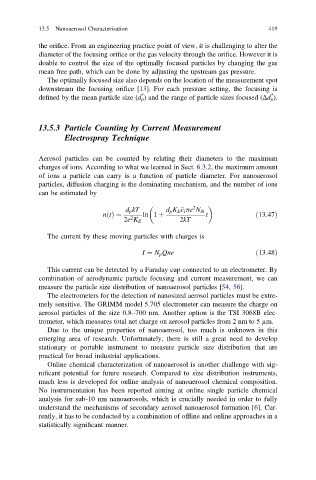
                                                       2
                                    d p kT     d p K E c i pe N i0
                              nðtÞ¼  2   ln 1 þ           t             ð13:47Þ
                                   2e K E          2kT
              The current by these moving particles with charges is

                                         I ¼ N p Qne                    ð13:48Þ

              This current can be detected by a Faraday cup connected to an electrometer. By
            combination of aerodynamic particle focusing and current measurement, we can
            measure the particle size distribution of nanoaerosol particles [54, 56].
              The electrometers for the detection of nanosized aerosol particles must be extre-
            mely sensitive. The GRIMM model 5.705 electrometer can measure the charge on
            aerosol particles of the size 0.8–700 nm. Another option is the TSI 3068B elec-
            trometer, which measures total net charge on aerosol particles from 2 nm to 5 µm.
              Due to the unique properties of nanoaerosol, too much is unknown in this
            emerging area of research. Unfortunately, there is still a great need to develop
            stationary or portable instrument to measure particle size distribution that are
            practical for broad industrial applications.
              Online chemical characterization of nanoaerosol is another challenge with sig-
            nificant potential for future research. Compared to size distribution instruments,
            much less is developed for online analysis of nanoaerosol chemical composition.
            No instrumentation has been reported aiming at online single particle chemical
            analysis for sub-10 nm nanoaerosols, which is crucially needed in order to fully
            understand the mechanisms of secondary aerosol nanoaerosol formation [6]. Cur-
            rently, it has to be conducted by a combination of offline and online approaches in a
            statistically significant manner.

