


Page 442 - Air pollution and greenhouse gases from basic concepts to engineering applications for air emission control
P. 442
422                                                   13 Nanoaerosol

              The output is neutralized monodisperse aerosol particle that is free of solvent
            residue. The particles are supposed to be spherical in shape. The sizes can be downs
            to a few nanometers. The factors that affect the concentration and the size distri-
            bution of nanoaerosols include solution concentration, humidity, and pressure.
            More about this technique can be found in literature (e.g., [37]).


            13.6.3 Soot Nanoaerosol Particles

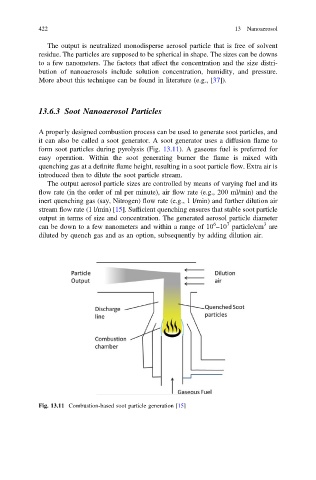
            A properly designed combustion process can be used to generate soot particles, and
            it can also be called a soot generator. A soot generator uses a diffusion flame to
            form soot particles during pyrolysis (Fig. 13.11). A gaseous fuel is preferred for
            easy operation. Within the soot generating burner the flame is mixed with
            quenching gas at a definite flame height, resulting in a soot particle flow. Extra air is
            introduced then to dilute the soot particle stream.
              The output aerosol particle sizes are controlled by means of varying fuel and its
            flow rate (in the order of ml per minute), air flow rate (e.g., 200 ml/min) and the
            inert quenching gas (say, Nitrogen) flow rate (e.g., 1 l/min) and further dilution air
            stream flow rate (1 l/min) [15]. Sufficient quenching ensures that stable soot particle
            output in terms of size and concentration. The generated aerosol particle diameter
                                                                7
                                                            6
                                                                          3
            can be down to a few nanometers and within a range of 10 –10 particle/cm are
            diluted by quench gas and as an option, subsequently by adding dilution air.


            Fig. 13.11 Combustion-based soot particle generation [15]

