


Page 128 - Air and gas Drilling Field Guide 3rd Edition
P. 128
5.6 Prime Mover Input Power Requirements       119


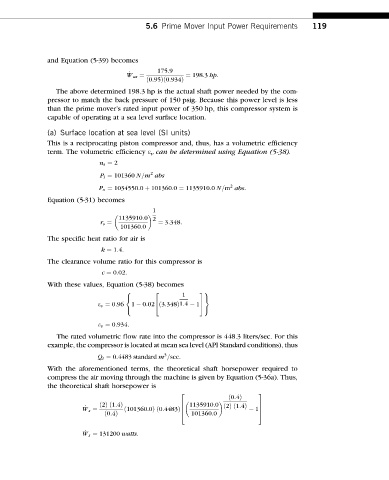
              and Equation (5-39) becomes
                                             175:9
                                     _ W as ¼       ¼ 198:3 hp:
                                          ð0:95Þð0:934Þ
                 The above determined 198.3 hp is the actual shaft power needed by the com-
              pressor to match the back pressure of 150 psig. Because this power level is less
              than the prime mover’s rated input power of 350 hp, this compressor system is
              capable of operating at a sea level surface location.
              (a) Surface location at sea level (SI units)
              This is a reciprocating piston compressor and, thus, has a volumetric efficiency
              term. The volumetric efficiency e v can be determined using Equation (5-38).
                             n s ¼ 2
                                           2
                             P i ¼ 101360 N=m abs
                                                                 2
                            P o ¼ 1034550:0 þ 101360:0 ¼ 1135910:0 N=m abs:
              Equation (5-31) becomes
                                           1

                                  1135910:0 2
                             r s ¼           ¼ 3:348:
                                  101360:0
              The specific heat ratio for air is
                             k ¼ 1:4:
              The clearance volume ratio for this compressor is
                             c ¼ 0:02:
              With these values, Equation (5-38) becomes
                                                   1
                                    8       2           39
                                    <                     =
                            e v ¼ 0:96  1   0:02 ð3:348Þ1:4   1 5
                                            4
                                    :                     ;
                            e v ¼ 0:934:
                 The rated volumetric flow rate into the compressor is 448.3 liters/sec. For this
              example, the compressor is located at mean sea level (API Standard conditions), thus
                                               3
                            Q i ¼ 0:4483 standard m =sec:
              With the aforementioned terms, the theoretical shaft horsepower required to
              compress the air moving through the machine is given by Equation (5-36a). Thus,
              the theoretical shaft horsepower is
                                                   2                     3
                                                                ð0:4Þ

                             ð2Þð1:4Þ              6  1135910:0 ð2Þð1:4Þ  7
                        _ W s ¼    ð101360:0Þð0:4483Þ 6                 1 7
                              ð0:4Þ                4  101360:0           5
                        _ W s ¼ 131200 watts:

