


Page 124 - Air and gas Drilling Field Guide 3rd Edition
P. 124
5.6 Prime Mover Input Power Requirements       115


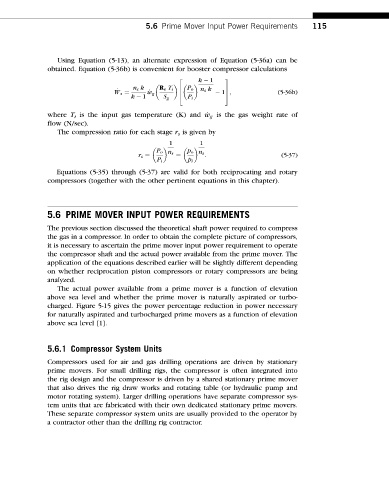
                 Using Equation (5-13), an alternate expression of Equation (5-36a) can be
              obtained. Equation (5-36b) is convenient for booster compressor calculations
                                                        k   1
                                                  2            3

                                      n s k          P o  n s k
                                                               7
                                 _ W s ¼  _ w g  R e T i 6     15;            (5-36b)
                                     k   1    S g  4  P i
              where T i is the input gas temperature (K) and _ w g is the gas weight rate of
              flow (N/sec).
                 The compression ratio for each stage r s is given by
                                                1       1

                                            P o n s  p o n s
                                       r s ¼      ¼       :                    (5-37)
                                             P i     p i
                 Equations (5-35) through (5-37) are valid for both reciprocating and rotary
              compressors (together with the other pertinent equations in this chapter).


              5.6 PRIME MOVER INPUT POWER REQUIREMENTS
              The previous section discussed the theoretical shaft power required to compress
              the gas in a compressor. In order to obtain the complete picture of compressors,
              it is necessary to ascertain the prime mover input power requirement to operate
              the compressor shaft and the actual power available from the prime mover. The
              application of the equations described earlier will be slightly different depending
              on whether reciprocation piston compressors or rotary compressors are being
              analyzed.
                 The actual power available from a prime mover is a function of elevation
              above sea level and whether the prime mover is naturally aspirated or turbo-
              charged. Figure 5-15 gives the power percentage reduction in power necessary
              for naturally aspirated and turbocharged prime movers as a function of elevation
              above sea level [1].


              5.6.1 Compressor System Units
              Compressors used for air and gas drilling operations are driven by stationary
              prime movers. For small drilling rigs, the compressor is often integrated into
              the rig design and the compressor is driven by a shared stationary prime mover
              that also drives the rig draw works and rotating table (or hydraulic pump and
              motor rotating system). Larger drilling operations have separate compressor sys-
              tem units that are fabricated with their own dedicated stationary prime movers.
              These separate compressor system units are usually provided to the operator by
              a contractor other than the drilling rig contractor.

