


Page 121 - Air and gas Drilling Field Guide 3rd Edition
P. 121
112     CHAPTER 5 Compressors and Nitrogen Generators


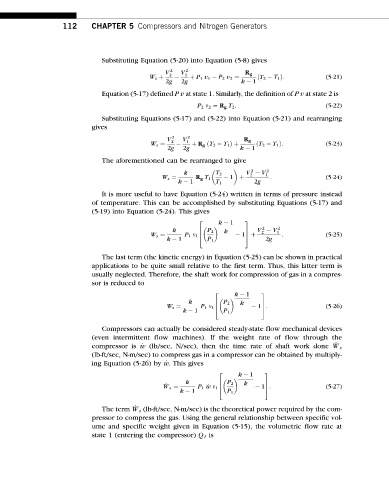
                             Substituting Equation (5-20) into Equation (5-8) gives
                                               V 2 2  V 1 2
                                          W s þ       þ P 1 v 1   P 2 v 2 ¼  R g  ð T 2   T 1 Þ:  (5-21)
                                               2g  2g               k   1
                             Equation (5-17) defined Pv at state 1. Similarly, the definition of Pv at state 2 is
                                                        P 2 n 2 ¼ R g T 2 :                (5-22)
                             Substituting Equations (5-17) and (5-22) into Equation (5-21) and rearranging
                          gives
                                               V 2 2  V 1 2          R g
                                           W s ¼      þ R g ðT 2   T 1 Þþ  ðT 2   T 1 Þ:   (5-23)
                                               2g   2g              k   1
                             The aforementioned can be rearranged to give
                                                                       2   2
                                                    k        T 2     V   V 1
                                                                      2
                                              W s ¼    R g T 1    1 þ       :              (5-24)
                                                  k   1      T 1       2g
                             It is more useful to have Equation (5-24) written in terms of pressure instead
                          of temperature. This can be accomplished by substituting Equations (5-17) and
                          (5-19) into Equation (5-24). This gives
                                                              k   1
                                                        2            3
                                                                          2   2
                                                 k        P 2  k        V   V
                                                        6            7   2    1
                                           W s ¼    P 1 n 14        15 þ       :           (5-25)
                                               k   1      P 1              2g
                             The last term (the kinetic energy) in Equation (5-25) can be shown in practical
                          applications to be quite small relative to the first term. Thus, this latter term is
                          usually neglected. Therefore, the shaft work for compression of gas in a compres-
                          sor is reduced to
                                                                  k   1
                                                            2            3

                                                     k         P 2  k
                                                            6            7
                                               W s ¼     P 1 n 14        15:               (5-26)
                                                    k   1      P 1
                             Compressors can actually be considered steady-state flow mechanical devices
                          (even intermittent flow machines). If the weight rate of flow through the
                          compressor is _ w (lb/sec, N/sec), then the time rate of shaft work done _ W s
                          (lb-ft/sec, N-m/sec) to compress gas in a compressor can be obtained by multiply-
                          ing Equation (5-26) by _ w. This gives
                                                                   k   1
                                                             2            3

                                                    k           P 2  k
                                                             6            7
                                               _ W s ¼  P 1 _ w n 14      15:              (5-27)
                                                   k   1        P 1
                             The term _ W s (lb-ft/sec, N-m/sec) is the theoretical power required by the com-
                          pressor to compress the gas. Using the general relationship between specific vol-
                          ume and specific weight given in Equation (5-15), the volumetric flow rate at
                          state 1 (entering the compressor) Q 1 is

