


Page 132 - Air and gas Drilling Field Guide 3rd Edition
P. 132
5.6 Prime Mover Input Power Requirements       123


              Values of the mechanical efficiency for typical rotary compressor systems can
              vary from about 0.84 to 0.99.
                 Illustrative Example 5.2 A two-stage helical lobe (screw) primary air com-
              pressor system unit is rated to have a volumetric flow rate of 950 scfm (448.3
              standard liters/sec) and a fixed design pressure output of 300 psig
                         2
              (206.9 N/cm gauge) at API Mechanical Equipment Standards atmospheric condi-
              tions. The compressor has a diesel prime mover that is rated to have a maximum
              power of 350 hp (261 kW) at a compressor shaft speed of 1800 rpm (at API
              Standard conditions). The prime mover is turbocharged. This rotary compressor
              system has a mechanical efficiency of 0.95.
                 Determine the horsepower required by the prime mover to operate the com-
                                                                      2
              pressor against a flow line back pressure of 150 psig (103.5 N/cm gauge) for (a)
              a surface location at sea level (use API Mechanical Equipment Standards atmo-
              spheric conditions for mean sea level) and (b) a surface location elevation of
              6000 ft (1829 m)(use average midlatitudes data in Table 5-1).


              (a) Surface location at sea level (USCS units)
              The rotary compressor is a fixed ratio machine. Therefore, the output of the com-
              pressor will be 300 psig.
                              n s ¼ 2

                              p i ¼ 14:696 psia
                             p o ¼ 300 þ 14:696 ¼ 314:696 psia:
              The total fixed compression ratio across the two stages of the compressor r tf is
                                 314:696
                             r tf ¼
                                  14:696
                             r tf ¼ 21:414:
              The rotary compressor volumetric efficiency e v is
                              e v ¼ 1:0:
                                                                  3
              The rated volumetric flow rate into the compressor is 950 ft /min. For this exam-
              ple, the compressor is located at mean sea level (API Standard conditions), thus,
                              q i ¼ 950 scfm:
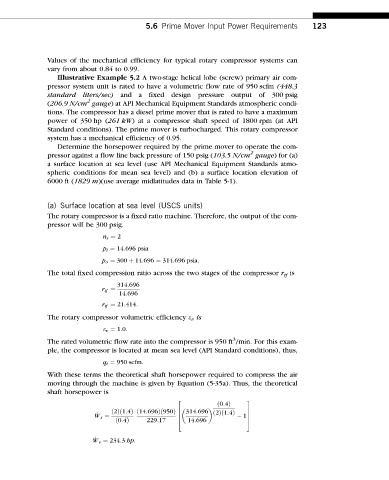
              With these terms the theoretical shaft horsepower required to compress the air
              moving through the machine is given by Equation (5-35a). Thus, the theoretical
              shaft horsepower is
                                                  2                  3
                                                             ð0:4Þ

                                ð2Þð1:4Þ ð14:696Þð950Þ 6  314:696 ð2Þð1:4Þ  7
                            _ W s ¼               6                  1 7
                                 ð0:4Þ    229:17  4  14:696          5
                           _ W s ¼ 234:3 hp:

