


Page 134 - Air and gas Drilling Field Guide 3rd Edition
P. 134
5.6 Prime Mover Input Power Requirements       125


                                                   2                    3
                                                                ð0:4Þ

                             ð2Þð1:4Þ              6  2170360:0 ð2Þð1:4Þ  7
                         _ W s ¼    ð101360:0Þð0:4483Þ 6               1 7
                              ð0:4Þ                4  101360:0          5
                         _ W s ¼ 174721 watts:
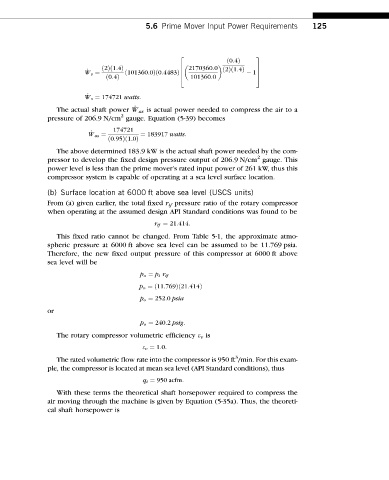
                 The actual shaft power _ W as is actual power needed to compress the air to a
                                  2
              pressure of 206.9 N/cm gauge. Equation (5-39) becomes
                                174721
                          _ W as ¼      ¼ 183917 watts:
                               ð0:95Þð1:0Þ
                 The above determined 183.9 kW is the actual shaft power needed by the com-
                                                                        2
              pressor to develop the fixed design pressure output of 206.9 N/cm gauge. This
              power level is less than the prime mover’s rated input power of 261 kW, thus this
              compressor system is capable of operating at a sea level surface location.

              (b) Surface location at 6000 ft above sea level (USCS units)
              From (a) given earlier, the total fixed r tf pressure ratio of the rotary compressor
              when operating at the assumed design API Standard conditions was found to be
                                            r tf ¼ 21:414:
                 This fixed ratio cannot be changed. From Table 5-1, the approximate atmo-
              spheric pressure at 6000 ft above sea level can be assumed to be 11.769 psia.
              Therefore, the new fixed output pressure of this compressor at 6000 ft above
              sea level will be

                                        p o ¼ p i r tf
                                        p o ¼ð11:769Þð21:414Þ
                                        p o ¼ 252:0 psia
              or
                                        p o ¼ 240:2 psig:

                 The rotary compressor volumetric efficiency e v is
                                         e v ¼ 1:0:
                                                                  3
                 The rated volumetric flow rate into the compressor is 950 ft /min. For this exam-
              ple, the compressor is located at mean sea level (API Standard conditions), thus
                                         q i ¼ 950 acfm:

                 With these terms the theoretical shaft horsepower required to compress the
              air moving through the machine is given by Equation (5-35a). Thus, the theoreti-
              cal shaft horsepower is

