


Page 136 - Air and gas Drilling Field Guide 3rd Edition
P. 136
5.6 Prime Mover Input Power Requirements       127


                                     P o ¼ P i r tf
                                     P o ¼ð81170:0Þð21:414Þ
                                                      2
                                     P o ¼ 1738174:4 N=m abs
              or
                                                      2
                                     P o ¼ 1657004:4 N=m gauge:
              The rotary compressor volumetric efficiency e v is
                                             e v ¼ 1:0:
                 The rated volumetric flow rate into the compressor is 448.3 liters/sec. For
              this example, the compressor is located at mean sea level (API Standard condi-
              tions), thus
                                                    3
                                         Q i ¼ 0:4483m =sec:
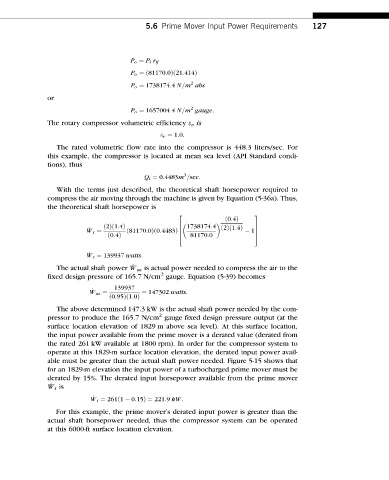
                 With the terms just described, the theoretical shaft horsepower required to
              compress the air moving through the machine is given by Equation (5-36a). Thus,
              the theoretical shaft horsepower is
                                                  2                     3
                                                               ð0:4Þ

                              ð2Þð1:4Þ            6  1738174:4 ð2Þð1:4Þ  7
                          _ W s ¼   ð81170:0Þð0:4483Þ 6                1 7
                               ð0:4Þ              4   81170:0           5
                          _ W s ¼ 139937 watts:
                 The actual shaft power _ W as is actual power needed to compress the air to the
                                              2
              fixed design pressure of 165.7 N/cm gauge. Equation (5-39) becomes
                                 139937
                          _ W as ¼      ¼ 147302 watts:
                               ð0:95Þð1:0Þ
                 The above determined 147.3 kW is the actual shaft power needed by the com-
                                             2
              pressor to produce the 165.7 N/cm gauge fixed design pressure output (at the
              surface location elevation of 1829 m above sea level). At this surface location,
              the input power available from the prime mover is a derated value (derated from
              the rated 261 kW available at 1800 rpm). In order for the compressor system to
              operate at this 1829-m surface location elevation, the derated input power avail-
              able must be greater than the actual shaft power needed. Figure 5-15 shows that
              for an 1829-m elevation the input power of a turbocharged prime mover must be
              derated by 15%. The derated input horsepower available from the prime mover
               _ W i is

                           _ W i ¼ 261ð1   0:15Þ¼ 221:9 kW:
                 For this example, the prime mover’s derated input power is greater than the
              actual shaft horsepower needed, thus the compressor system can be operated
              at this 6000-ft surface location elevation.

