


Page 161 - Air and gas Drilling Field Guide 3rd Edition
P. 161
152 CHAPTER 6 Direct Circulation Models
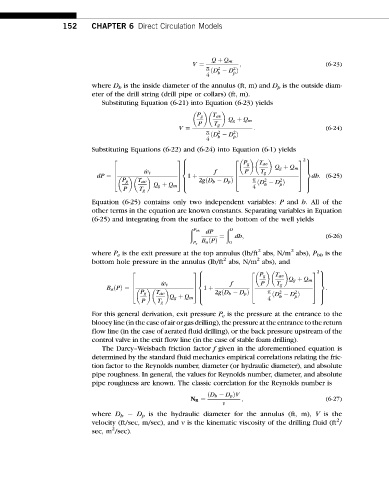
Q þ Q m
V ¼ ; (6-23)
2 2
ðD D Þ
p
4 h p
where D h is the inside diameter of the annulus (ft, m) and D p is the outside diam-
eter of the drill string (drill pipe or collars) (ft, m).
Substituting Equation (6-21) into Equation (6-23) yields
P g T av
Q g þ Q m
P T g
V ¼ : (6-24)
2 2
p
ðD D Þ
p
h
4
Substituting Equations (6-22) and (6-24) into Equation (6-1) yields
8 9
32
2 3 2
P g T av
> >
> >
> Q g þ Q m >
< f P =
6 _ w t 7 6 T g 7
6 7 1 þ 6 7 dh: (6-25)
dP ¼
4 5 2gðD h D p Þ 4 2 2 5
P g T av > p >
h
p
> ðD D Þ >
> 4 >
P T g Q g þ Q m : ;
Equation (6-25) contains only two independent variables: P and h. All of the
other terms in the equation are known constants. Separating variables in Equation
(6-25) and integrating from the surface to the bottom of the well yields
ð ð H
P bh
dP
¼ dh; (6-26)
B a ðPÞ
P e 0
2
2
where P e is the exit pressure at the top annulus (lb/ft abs, N/m abs), P bh is the
2
2
bottom hole pressure in the annulus (lb/ft abs, N/m abs), and
8 9
32
2 3 2
P g T av
> >
> >
> Q g þ Q m >
< f P =
6 _ w t 7 6 T g 7
6 7 1 þ 6 7 :
B a ðPÞ¼
4 5 2gðD h D p Þ 4 2 2 5
P g T av > p ðD D Þ >
> h p >
> 4 >
P T g Q g þ Q m : ;
For this general derivation, exit pressure P e is the pressure at the entrance to the
blooey line (in the case of air or gas drilling), the pressure at the entrance to the return
flow line (in the case of aerated fluid drilling), or the back pressure upstream of the
control valve in the exit flow line (in the case of stable foam drilling).
The Darcy–Weisbach friction factor f given in the aforementioned equation is
determined by the standard fluid mechanics empirical correlations relating the fric-
tion factor to the Reynolds number, diameter (or hydraulic diameter), and absolute
pipe roughness. In general, the values for Reynolds number, diameter, and absolute
pipe roughness are known. The classic correlation for the Reynolds number is
ðD h D p ÞV
N R ¼ ; (6-27)
n
where D h D p is the hydraulic diameter for the annulus (ft, m), V is the
2
velocity (ft/sec, m/sec), and n is the kinematic viscosity of the drilling fluid (ft /
2
sec, m /sec).

