


Page 166 - Air and gas Drilling Field Guide 3rd Edition
P. 166
6.3 Aerated Fluid Drilling Model   157


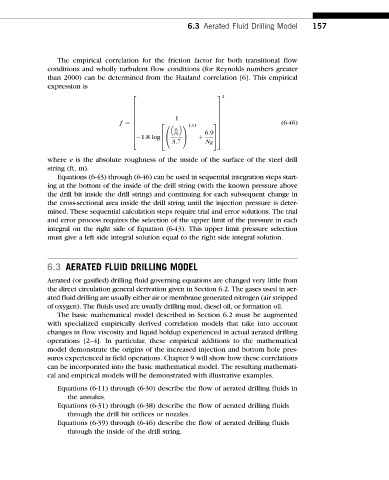
                 The empirical correlation for the friction factor for both transitional flow
              conditions and wholly turbulent flow conditions (for Reynolds numbers greater
              than 2000) can be determined from the Haaland correlation [6]. This empirical
              expression is
                                                               2
                                      2                      3
                                      6                      7
                                      6                      7
                                      6                      7
                                                  1
                                      6                      7
                                  f ¼  6     2     11:11    3 7                (6-46)
                                               0
                                      6                      7
                                                  e
                                      6                      7
                                                 D i
                                      6                   6:9 7 7
                                             6
                                               @    A
                                      4                 þ   5 5
                                        1:8 log4
                                                 3:7      N R
              where e is the absolute roughness of the inside of the surface of the steel drill
              string (ft, m).
                 Equations (6-43) through (6-46) can be used in sequential integration steps start-
              ing at the bottom of the inside of the drill string (with the known pressure above
              the drill bit inside the drill string) and continuing for each subsequent change in
              the cross-sectional area inside the drill string until the injection pressure is deter-
              mined. These sequential calculation steps require trial and error solutions. The trial
              and error process requires the selection of the upper limit of the pressure in each
              integral on the right side of Equation (6-43). This upper limit pressure selection
              must give a left side integral solution equal to the right side integral solution.
              6.3 AERATED FLUID DRILLING MODEL
              Aerated (or gasified) drilling fluid governing equations are changed very little from
              the direct circulation general derivation given in Section 6.2. The gases used in aer-
              ated fluid drilling are usually either air or membrane generated nitrogen (air stripped
              of oxygen). The fluids used are usually drilling mud, diesel oil, or formation oil.
                 The basic mathematical model described in Section 6.2 must be augmented
              with specialized empirically derived correlation models that take into account
              changes in flow viscosity and liquid holdup experienced in actual aerated drilling
              operations [2–4]. In particular, these empirical additions to the mathematical
              model demonstrate the origins of the increased injection and bottom hole pres-
              sures experienced in field operations. Chapter 9 will show how these correlations
              can be incorporated into the basic mathematical model. The resulting mathemati-
              cal and empirical models will be demonstrated with illustrative examples.

                 Equations (6-11) through (6-30) describe the flow of aerated drilling fluids in
                    the annulus.
                 Equations (6-31) through (6-38) describe the flow of aerated drilling fluids
                    through the drill bit orifices or nozzles.
                 Equations (6-39) through (6-46) describe the flow of aerated drilling fluids
                    through the inside of the drill string.

