


Page 171 - Air and gas Drilling Field Guide 3rd Edition
P. 171
162     CHAPTER 6 Direct Circulation Models


                          Equations (6-30), (6-55), (6-56), (6-60), and (6-61) can be used in sequential calcu-
                          lation steps starting at the top of the annulus and continuing for each subsequent
                          change in cross-sectional area in the annulus until the bottom hole pressure is
                          determined.
                             The flow condition through the drill bit orifices or nozzles is single phase (air
                          or gas) flow. The character (sonic or subsonic) of the gas flow through the drill
                          bit orifices or nozzles is determined by the critical pressure ratio equation. The
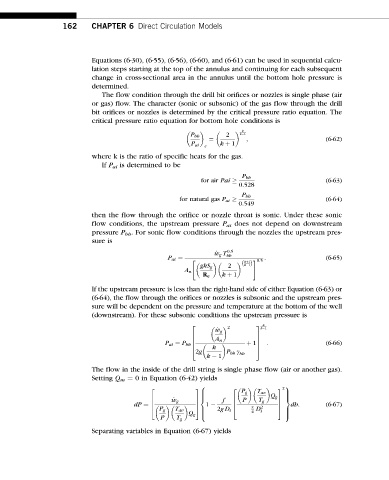
                          critical pressure ratio equation for bottom hole conditions is

                                                                    k
                                                      P bh      2  k 1
                                                           ¼         ;                     (6-62)
                                                      P ai    k þ 1
                                                          c
                          where k is the ratio of specific heats for the gas.
                             If P ai is determined to be
                                                                    P bh
                                                         for air Pai                       (6-63)
                                                                   0:528
                                                                    P bh
                                                   for natural gas P ai                    (6-64)
                                                                   0:549
                          then the flow through the orifice or nozzle throat is sonic. Under these sonic
                          flow conditions, the upstream pressure P ai does not depend on downstream
                          pressure P bh . For sonic flow conditions through the nozzles the upstream pres-
                          sure is

                                                             _ w g T  0:5
                                                P ai ¼          bh        :                (6-65)
                                                      "                # 0:5
                                                                    ðÞ
                                                                     kþ1
                                                         gkS g  2    k 1
                                                    A n
                                                               k þ 1
                                                         R e
                          If the upstream pressure is less than the right-hand side of either Equation (6-63) or
                          (6-64), the flow through the orifices or nozzles is subsonic and the upstream pres-
                          sure will be dependent on the pressure and temperature at the bottom of the well
                          (downstream). For these subsonic conditions the upstream pressure is
                                                                        3 k
                                                      2
                                                                 2       k 1
                                                             _ w g
                                                      6                 7
                                                             A n
                                                                        7
                                                      6              þ 17 :                (6-66)

                                                            k
                                               P ai ¼ P bh6
                                                      4                 5
                                                       2g       P bh g bh
                                                          k   1
                          The flow in the inside of the drill string is single phase flow (air or another gas).
                          Setting Q m ¼ 0 in Equation (6-42) yields
                                                        8                       9
                                                                              32
                                           2           3         2
                                                                    P g  T av
                                                        >                       >
                                                        >                       >
                                                                            Q g
                                                        >                       >
                                                        <                       =
                                           6     _ w g  7      f  6  P   T g  7
                                           6           7  1      6            7   dh:      (6-67)
                                      dP ¼                               2
                                             P g  T av  >    2gD i       i      >
                                           4           5         4     p  D   5
                                                        >              4        >
                                                        >                       >
                                             P    T g  Q g :                    ;
                          Separating variables in Equation (6-67) yields

