


Page 169 - Air and gas Drilling Field Guide 3rd Edition
P. 169
160     CHAPTER 6 Direct Circulation Models


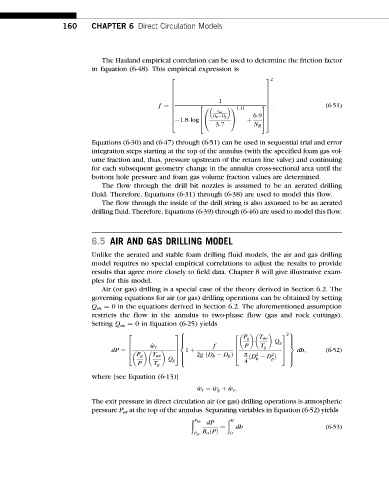
                             The Haaland empirical correlation can be used to determine the friction factor
                          in Equation (6-48). This empirical expression is
                                                                            2
                                                2                          3
                                                6                          7
                                                6                          7
                                                6                          7
                                                              1
                                                6                          7
                                             f ¼  6     2         11:11   3 7  :           (6-51)
                                                         0
                                                6                          7
                                                             e av
                                                6                          7
                                                            D h  D p
                                                6                      6:9 7 7
                                                        6
                                                         @       A
                                                4                    þ    5 5
                                                  1:8 log4
                                                             3:7       N R
                          Equations (6-30) and (6-47) through (6-51) can be used in sequential trial and error
                          integration steps starting at the top of the annulus (with the specified foam gas vol-
                          ume fraction and, thus, pressure upstream of the return line valve) and continuing
                          for each subsequent geometry change in the annulus cross-sectional area until the
                          bottom hole pressure and foam gas volume fraction values are determined.
                             The flow through the drill bit nozzles is assumed to be an aerated drilling
                          fluid. Therefore, Equations (6-31) through (6-38) are used to model this flow.
                             The flow through the inside of the drill string is also assumed to be an aerated
                          drilling fluid. Therefore, Equations (6-39) through (6-46) are used to model this flow.
                          6.5 AIR AND GAS DRILLING MODEL
                          Unlike the aerated and stable foam drilling fluid models, the air and gas drilling
                          model requires no special empirical correlations to adjust the results to provide
                          results that agree more closely to field data. Chapter 8 will give illustrative exam-
                          ples for this model.
                             Air (or gas) drilling is a special case of the theory derived in Section 6.2. The
                          governing equations for air (or gas) drilling operations can be obtained by setting
                          Q m ¼ 0 in the equations derived in Section 6.2. The aforementioned assumption
                          restricts the flow in the annulus to two-phase flow (gas and rock cuttings).
                          Setting Q m ¼ 0 in Equation (6-25) yields
                                                   8                             9
                                                                               32
                                    2             3               2
                                                                    P g  T av
                                                   >                             >
                                                   >                             >
                                                   >                         Q g  >
                                                   <        f        P           =
                                    6      _ w t  7               6      T g   7
                                    6             7               6            7   dh;     (6-52)
                                dP ¼                1 þ
                                    4             5               4     2   2  5
                                       P g  T av   >    2g ðD h   D p Þ  p  ðD   D Þ  >
                                                   >                    h   p    >
                                                   >                 4           >
                                       P    T g  Q g :                           ;
                          where [see Equation (6-13)]
                                                        _ w t ¼ _ w g þ _ w s :
                          The exit pressure in direct circulation air (or gas) drilling operations is atmospheric
                          pressure P at at the top of the annulus. Separating variables in Equation (6-52) yields
                                                      ð         ð H
                                                       P bh
                                                          dP
                                                              ¼   dh                       (6-53)
                                                         B a ðPÞ
                                                       P at      0

