


Page 168 - Air and gas Drilling Field Guide 3rd Edition
P. 168
6.4 Stable Foam Drilling Model    159


                                            8                                9
                                                                           32
                         2                3               2
                                                             P g  T av
                                            >                                >
                                            >                                >
                                            >                        Q g þ Q f  >
                                            <        f       P               =
                         6        _ w t   7               6      T g       7
                         6                7               6                7   :
                  B a ðPÞ¼                   1 þ                  2    2
                           P g  T av        >   2gðD h   D p Þ  ðD   D Þ     >
                         4                5               4    p           5
                                                                  h
                                                                       p
                                            >                  4             >
                                            >                                >
                            P   T g                                          ;
                                    Q g þ Q f :
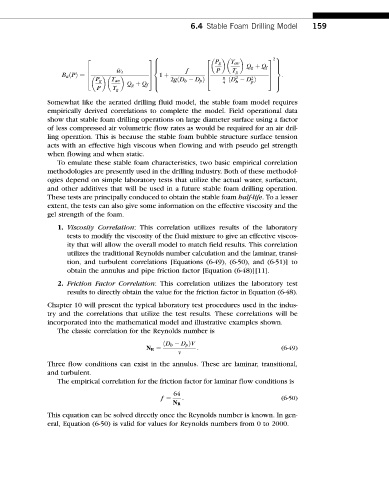
              Somewhat like the aerated drilling fluid model, the stable foam model requires
              empirically derived correlations to complete the model. Field operational data
              show that stable foam drilling operations on large diameter surface using a factor
              of less compressed air volumetric flow rates as would be required for an air dril-
              ling operation. This is because the stable foam bubble structure surface tension
              acts with an effective high viscous when flowing and with pseudo gel strength
              when flowing and when static.
                 To emulate these stable foam characteristics, two basic empirical correlation
              methodologies are presently used in the drilling industry. Both of these methodol-
              ogies depend on simple laboratory tests that utilize the actual water, surfactant,
              and other additives that will be used in a future stable foam drilling operation.
              These tests are principally conduced to obtain the stable foam half-life. To a lesser
              extent, the tests can also give some information on the effective viscosity and the
              gel strength of the foam.
                 1. Viscosity Correlation: This correlation utilizes results of the laboratory
                    tests to modify the viscosity of the fluid mixture to give an effective viscos-
                    ity that will allow the overall model to match field results. This correlation
                    utilizes the traditional Reynolds number calculation and the laminar, transi-
                    tion, and turbulent correlations [Equations (6-49), (6-50), and (6-51)] to
                    obtain the annulus and pipe friction factor [Equation (6-48)][11].
                 2. Friction Factor Correlation: This correlation utilizes the laboratory test
                    results to directly obtain the value for the friction factor in Equation (6-48).
              Chapter 10 will present the typical laboratory test procedures used in the indus-
              try and the correlations that utilize the test results. These correlations will be
              incorporated into the mathematical model and illustrative examples shown.
                 The classic correlation for the Reynolds number is
                                              ðD h   D p ÞV
                                          N R ¼         :                      (6-49)
                                                  n
              Three flow conditions can exist in the annulus. These are laminar, transitional,
              and turbulent.
                 The empirical correlation for the friction factor for laminar flow conditions is
                                                 64
                                              f ¼  N R  :                      (6-50)
              This equation can be solved directly once the Reynolds number is known. In gen-
              eral, Equation (6-50) is valid for values for Reynolds numbers from 0 to 2000.

