


Page 219 - Air and gas Drilling Field Guide 3rd Edition
P. 219
210     CHAPTER 8 Air, Gas, and Unstable Foam Drilling


                                                                    2
                                                         Pressure (N/cm abs)
                                      0            500          1000         1500
                                  12.00

                                  11.50

                                  11.00

                                 % Oxygen 10.50
                                  10.00

                                   9.50

                                   9.00

                                   8.50

                                   8.00
                                      0       500     1000    1500     2000    2500    3000
                                                          Pressure (psia)

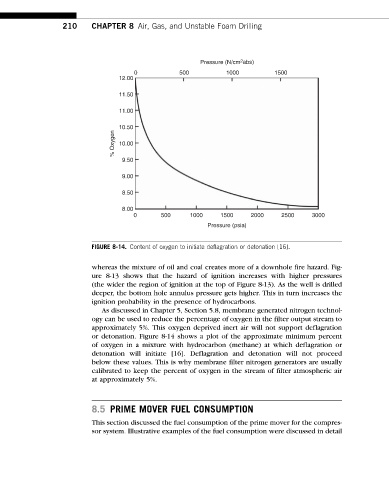
                          FIGURE 8-14. Content of oxygen to initiate deflagration or detonation [16].


                          whereas the mixture of oil and coal creates more of a downhole fire hazard. Fig-
                          ure 8-13 shows that the hazard of ignition increases with higher pressures
                          (the wider the region of ignition at the top of Figure 8-13). As the well is drilled
                          deeper, the bottom hole annulus pressure gets higher. This in turn increases the
                          ignition probability in the presence of hydrocarbons.
                             As discussed in Chapter 5, Section 5.8, membrane generated nitrogen technol-
                          ogy can be used to reduce the percentage of oxygen in the filter output stream to
                          approximately 5%. This oxygen deprived inert air will not support deflagration
                          or detonation. Figure 8-14 shows a plot of the approximate minimum percent
                          of oxygen in a mixture with hydrocarbon (methane) at which deflagration or
                          detonation will initiate [16]. Deflagration and detonation will not proceed
                          below these values. This is why membrane filter nitrogen generators are usually
                          calibrated to keep the percent of oxygen in the stream of filter atmospheric air
                          at approximately 5%.


                          8.5 PRIME MOVER FUEL CONSUMPTION
                          This section discussed the fuel consumption of the prime mover for the compres-
                          sor system. Illustrative examples of the fuel consumption were discussed in detail

