


Page 596 - Aircraft Stuctures for Engineering Student
P. 596
Problems  577

           .   /.  ... ". .,~.,~..   ,  .   ."

             P.13.1  An initially untwisted rectangular wing of semi-span s and chord c has its
           flexural axis normal to the plane of symmetry, and is of constant cross-section with
           torsional  rigidity  GJ. The aerodynamic centre is ec ahead of the flexural axis, the
           lift-coefficient slope is a and the pitching moment coefficient at zero lift is  Cm.o. At
           speed V in air of density p the wing-root incidence from zero lift is ao.
             Using simple strip-theory, i.e. ignoring downwash effects, show that the incidence
           at a section distant y  from the plane of symmetry is given by
                             ao+e= (2+ao)
                                                 COS X(S - Y)  Cm.0
                                                              ea
                                                   cos As   -~
           where
                                             ea+pv2c2
                                         A=
                                                GJ
           Hence, assuming Cm,o to be negative, find the condition giving the speed at which the
           lift would be reduced to zero.
             Ans.  V = d-  ~ G J
                         2pec2s2a
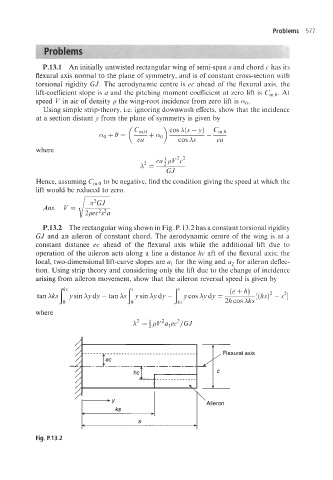
             P.13.2  The rectangular wing shown in Fig. P. 13.2 has a constant torsional rigidity
           GJ and an aileron of constant chord. The aerodynamic centre of the wing is at a
           constant  distance  ec  ahead  of  the  flexural  axis  while  the  additional  lift  due  to
           operation  of the aileron acts along a line a distance hc aft of the flexural axis; the
           local, two-dimensional lift-curve slopes are al for the wing and a2 for aileron deflec-
           tion. Using strip theory and considering only the lift due to the change of incidence
           arising from aileron movement, show that the aileron reversal speed is given by
                                                  .I              (e + h)
            tan Xks 1;  y sin Ay dy - tan As  y sin Xy dy -   y cos Xy dy =  2h cos Xks  [ (ks)  - s2]
           where
                                       X2 = ;pV2alec2/GJ


                                                                      axis


                        I                                I
           Fig. P.13.2

