


Page 626 -
P. 626
606   CHAPTER 14 MULTICRITERIA DECISIONS


                                       To solve the Suncoast Office Supplies problem, we begin by solving the P 1 problem:
                                                    þ
                                            Min    d þ d
                                                        2
                                                    1
                                             s:t:
                                                              þ
                                                   2E þ  3N   d þ d                   ¼    680 Goal 1
                                                              1   1
                                                                  þ
                                                   2E þ  3N       d þ d               ¼    600 Goal 2
                                                                       2
                                                                  2
                                                                       þ
                                                 250E þ 125N          d þ d           ¼ 70 000 Goal 3
                                                                       3   3
                                                                           þ
                                                   E                       d þ d       ¼   200 Goal 4
                                                                                4
                                                                           4
                                                                                þ
                                                          N                    d þ d    ¼  120 Goal 5
                                                                                5   5
                                                  þ


                                                        þ

                                                                         þ

                                                             þ

                                                                   þ
                                             E; N; d ; d ; d ; d ; d ; d ; d ; d ; d ; d   0
                                                        2
                                                           2
                                                  1
                                                     1
                                                             3
                                                                         5
                                                                            5
                                                                      4
                                                                3
                                                                   4
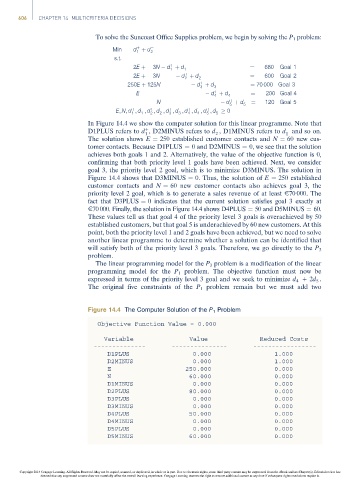
                                     In Figure 14.4 we show the computer solution for this linear programme. Note that

                                                      þ

                                     D1PLUS refers to d , D2MINUS refers to d , D1MINUS refers to d and so on.
                                                      1                     2                    1
                                     The solution shows E ¼ 250 established customer contacts and N ¼ 60 new cus-
                                     tomer contacts. Because D1PLUS ¼ 0 and D2MINUS ¼ 0, we see that the solution
                                     achieves both goals 1 and 2. Alternatively, the value of the objective function is 0,
                                     confirming that both priority level 1 goals have been achieved. Next, we consider
                                     goal 3, the priority level 2 goal, which is to minimize D3MINUS. The solution in
                                     Figure 14.4 shows that D3MINUS ¼ 0. Thus, the solution of E ¼ 250 established
                                     customer contacts and N ¼ 60 new customer contacts also achieves goal 3, the
                                     priority level 2 goal, which is to generate a sales revenue of at least E70 000. The
                                     fact that D3PLUS ¼ 0 indicates that the current solution satisfies goal 3 exactly at
                                     E70000. Finally, the solution in Figure 14.4 shows D4PLUS ¼ 50 and D5MINUS ¼ 60.
                                     These values tell us that goal 4 of the priority level 3 goals is overachieved by 50
                                     established customers, but that goal 5 is underachieved by 60 new customers. At this
                                     point, both the priority level 1 and 2 goals have been achieved, but we need to solve
                                     another linear programme to determine whether a solution can be identified that
                                     will satisfy both of the priority level 3 goals. Therefore, we go directly to the P 3
                                     problem.
                                       The linear programming model for the P 3 problem is a modification of the linear
                                     programming model for the P 1 problem. The objective function must now be


                                     expressed in terms of the priority level 3 goal and we seek to minimize d 4 +2d 5 .
                                     The original five constraints of the P 1 problem remain but we must add two
                                     Figure 14.4 The Computer Solution of the P 1 Problem
                                        Objective Function Value = 0.000
                                         Variable               Value              Reduced Costs
                                      --------------       ---------------       -----------------
                                           D1PLUS                 0.000                 1.000
                                           D2MINUS                0.000                 1.000
                                           E                    250.000                 0.000
                                           N                     60.000                 0.000
                                           D1MINUS                0.000                 0.000
                                           D2PLUS                80.000                 0.000
                                           D3PLUS                 0.000                 0.000
                                           D3MINUS                0.000                 0.000
                                           D4PLUS                50.000                 0.000
                                           D4MINUS                0.000                 0.000
                                           D5PLUS                 0.000                 0.000
                                           D5MINUS               60.000                 0.000
                Copyright 2014 Cengage Learning. All Rights Reserved. May not be copied, scanned, or duplicated, in whole or in part. Due to electronic rights, some third party content may be suppressed from the eBook and/or eChapter(s). Editorial review has
                      deemed that any suppressed content does not materially affect the overall learning experience. Cengage Learning reserves the right to remove additional content at any time if subsequent rights restrictions require it.

