


Page 621 -
P. 621
GOAL PROGRAMMING: FORMULATION AND GRAPHICAL SOLUTION  601


                      Problem 2 will test your  Although the graphical solution procedure is a convenient method for solving goal
                      ability to formulate a goal  programming problems involving two decision variables, the solution of larger prob-
                      programming model and
                      use the graphical solution  lems requires a computer-aided approach. In Section 14.2 we illustrate how to use a
                      procedure to obtain a  computer software package to solve more complex goal programming problems.
                      solution.
                                      Goal Programming Model
                                      As we stated, preemptive goal programming problems are solved as a sequence of
                                      linear programmes: one linear programme for each priority level. However, notation
                                      that permits writing a goal programming problem in one concise statement is helpful.
                                         In writing the overall objective for the portfolio selection problem, we must write
                                      the objective function in a way that reminds us of the preemptive priorities. We can
                                      do so by writing the objective function as:
                                                                          þ

                                                                  Min  P 1 ðd Þþ P 2 ðd Þ
                                                                                 2
                                                                          1
                                      The priority levels P 1 and P 2 are not numerical weights on the deviation variables,
                                      but simply labels that remind us of the priority levels for the goals.
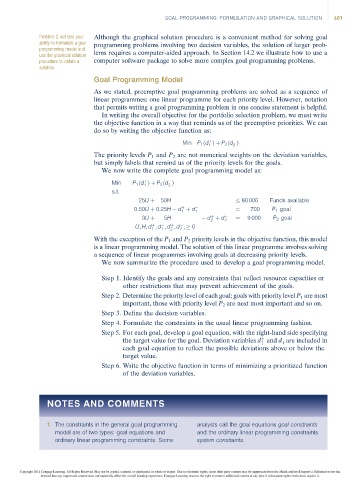
                                         We now write the complete goal programming model as:

                                                      þ
                                            Min   P 1 ðd Þþ P 2 ðd Þ
                                                      1      2
                                            s:t:
                                                    25U þ  50H                      80 000  Funds available
                                                                 þ
                                                   0:50U þ 0:25H   d þ d          ¼   700    P 1 goal
                                                                 1
                                                                      1
                                                                          þ
                                                     3U þ   5H           d þ d    ¼   9 000  P 2 goal
                                                                          2    2

                                                        þ
                                                              þ

                                                   U; H; d ; d ; d ; d ;   0
                                                        1  1  2  2
                                      With the exception of the P 1 and P 2 priority levels in the objective function, this model
                                      is a linear programming model. The solution of this linear programme involves solving
                                      a sequence of linear programmes involving goals at decreasing priority levels.
                                         We now summarize the procedure used to develop a goal programming model.
                                         Step 1. Identify the goals and any constraints that reflect resource capacities or
                                               other restrictions that may prevent achievement of the goals.
                                         Step 2. Determine the priority level of each goal; goals with priority level P 1 are most
                                               important, those with priority level P 2 are next most important and so on.
                                         Step 3. Define the decision variables.
                                         Step 4. Formulate the constraints in the usual linear programming fashion.
                                         Step 5. For each goal, develop a goal equation, with the right-hand side specifying
                                                                                          þ

                                               the target value for the goal. Deviation variables d and d are included in
                                                                                          1     1
                                               each goal equation to reflect the possible deviations above or below the
                                               target value.
                                         Step 6. Write the objective function in terms of minimizing a prioritized function
                                               of the deviation variables.


                        NOTES AND COMMENTS


                        1 The constraints in the general goal programming  analysts call the goal equations goal constraints
                          model are of two types: goal equations and  and the ordinary linear programming constraints
                          ordinary linear programming constraints. Some  system constraints.


                Copyright 2014 Cengage Learning. All Rights Reserved. May not be copied, scanned, or duplicated, in whole or in part. Due to electronic rights, some third party content may be suppressed from the eBook and/or eChapter(s). Editorial review has
                      deemed that any suppressed content does not materially affect the overall learning experience. Cengage Learning reserves the right to remove additional content at any time if subsequent rights restrictions require it.

