


Page 625 -
P. 625
GOAL PROGRAMMING: SOLVING MORE COMPLEX PROBLEMS 605
at least E70 000, and if d > 0; revenues of less than E70 000 will be obtained. Thus,
3
the objective function for the priority level 2 problem is:
Min d 3
Next, we consider what the objective function must be for the priority level 3
problem. When considering goal 4, if d ¼ 0; we will have found a solution with at
4
least 200 established customer contacts; however, if d > 0; we will have underach-
4
ieved the goal of contacting at least 200 established customers. Thus, for goal 4 the
objective is to minimize d . When considering goal 5, if d ¼ 0; we will have found a
4 5
solution with at least 120 new customer contacts; however, if d > 0; we will have
5
underachieved the goal of contacting at least 120 new customers. Thus, for goal 5 the
objective is to minimize d : If both goals 4 and 5 are equal in importance, the
5
objective function for the priority level 3 problem would be:
Min d þ d
4
5
However, suppose that management believes that generating new customers is vital
to the long-run success of the firm and that goal 5 should be weighted more than
goal 4. If management believes that goal 5 is twice as important as goal 4, the
objective function for the priority level 3 problem would be:
Min d þ 2d
4 5
Combining the objective functions for all three priority levels, we obtain the
overall objective function for the Suncoast Office Supplies problem:
þ
Min P 1 ðd Þþ P 1 ðd Þþ P 2 ðd Þþ P 3 ðd Þþ P 3 ð2d Þ
5
1
4
2
3
As we indicated previously, P 1 , P 2 and P 3 are simply labels that remind us that goals
1 and 2 are the priority level 1 goals, goal 3 is the priority level 2 goal and goals 4 and
5 are the priority level 3 goals. We can now write the complete goal programming
model for the Suncoast Office Supplies problem as follows:
þ
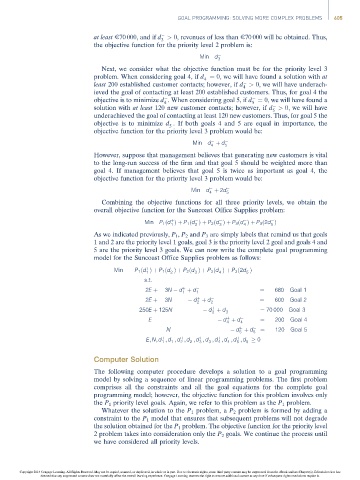
Min P 1 ðd Þþ P 1 ðd Þþ P 2 ðd Þþ P 3 ðd Þþ P 3 ð2d Þ
1 2 3 4 5
s:t:
þ
2E þ 3N d þ d ¼ 680 Goal 1
1
1
þ
2E þ 3N d þ d 2 ¼ 600 Goal 2
2
þ
250E þ 125N d þ d ¼ 70 000 Goal 3
3 3
þ
E d þ d ¼ 200 Goal 4
4 4
þ
N d þ d ¼ 120 Goal 5
5
5
þ
þ
þ
þ
þ
E; N; d ; d ; d ; d ; d ; d ; d ; d ; d ; d 0
5
1
5
4
4
3
3
1
2
2
Computer Solution
The following computer procedure develops a solution to a goal programming
model by solving a sequence of linear programming problems. The first problem
comprises all the constraints and all the goal equations for the complete goal
programming model; however, the objective function for this problem involves only
the P 1 priority level goals. Again, we refer to this problem as the P 1 problem.
Whatever the solution to the P 1 problem, a P 2 problem is formed by adding a
constraint to the P 1 model that ensures that subsequent problems will not degrade
the solution obtained for the P 1 problem. The objective function for the priority level
2 problem takes into consideration only the P 2 goals. We continue the process until
we have considered all priority levels.
Copyright 2014 Cengage Learning. All Rights Reserved. May not be copied, scanned, or duplicated, in whole or in part. Due to electronic rights, some third party content may be suppressed from the eBook and/or eChapter(s). Editorial review has
deemed that any suppressed content does not materially affect the overall learning experience. Cengage Learning reserves the right to remove additional content at any time if subsequent rights restrictions require it.

