


Page 374 - Analog and Digital Filter Design
P. 374
Introduction to Digital Filters   3


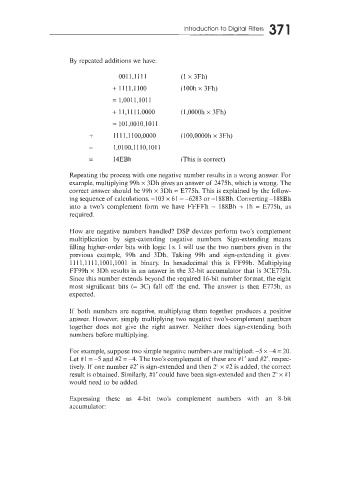
                      By repeated additions we have:

                                     001 1,111 1        (1 x 3Fh)
                                   + 1111,1100          (100h x 3Fh)
                                   = 1,001 1,101 1
                                   + 11,1111.0000       (1,0000h x 3Fh)

                                   = 101,0010,1011
                            +       11 11,1100,0000     (100,OOOOh x 3Fh)


                            -
                            -       1,0100,1110,101 1
                            -       14EBh               (This is correct)
                            -
                      Repeating the process with one negative number results in a wrong answer. For
                      example, multiplying 99h x 3Dh gives an answer of 24731, which is wrong. The
                      correct answer should be 99h x 3Dh = E775h. This is explained by the follow-
                      ing sequence of calculations. -103  x 61 = -6283  or -188Bh.  Converting -188Bh
                      into  a  two’s complement  form  we  have  FFFFh - 188Bh +  Ih = E775h,  as
                      required.

                      How are negative numbers handled? DSP devices perform  two’s complement
                      multiplication  by  sign-extending  negative  numbers.  Sign-extending  means
                      filling higher-order bits with logic 1 s.  I will  use the two numbers given in the
                      previous  example,  99h  and  3Dh.  Taking  99h  and  sign-extending  it  gives:
                      1111,1111,1001,1001 in  binary.  In  hexadecimal  this  is  FF99h.  Multiplying
                      FF99h x 3Dh results in an answer in the 32-bit accumulator that is 3CE775h.
                      Since this number extends beyond the required  16-bit number format, the eight
                      most  significant  bits  (= 3C) fall  off  the  end.  The answer  is  then  E775h,  as
                      expected.

                      If  both numbers  are negative, multiplying  them  together  produces a  positive
                      answer. However, simply multiplying two negative two’s-complement numbers
                      together  does  not  give  the  right  answer.  Neither  does  sign-extending  both
                      numbers before multiplying.

                      For example, suppose two simple negative numbers are multiplied: -5  x -4  = 20.
                      Let #1 = -5  and #2 = -4.  The two’s complement of these are #1’ and #2’.  respec-
                      tively. If  one number #2’ is sign-extended and then 2“ x #2 is added, the correct
                      result is obtained. Similarly, #1’ could have been sign-extended and then 2“ x #I
                      would need to be added.

                      Expressing  these  as  +bit  two’s  complement  numbers  with  an  %bit
                      accumulator:

