


Page 376 - Analog and Digital Filter Design
P. 376
Introduction to Digital Filters  373


                       16                              1
                       S                                1
                                      X                .,   Multiply two Q15 numbers
                       16

                                      II
                       32   30                            Q30 Result                     I


                                         I
                                     16 bit (Q15) result
                                       \G  Shift left, then save bits 17 to 32
                       16                              1
                       ]SI  j  I  I  I  I  I  I  I  I  1  I  I   I   Q15 Result

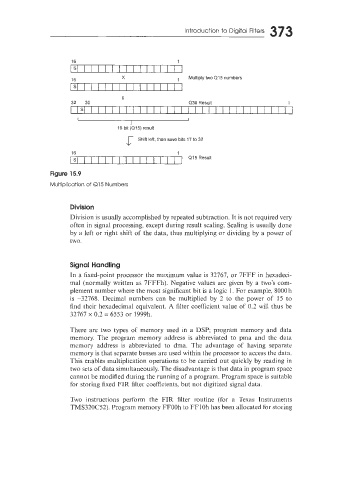
                Figure 15.9
                Multiplication of Q15 Numbers


                      Division
                      Division is usually accomplished by repeated subtraction. It is not required very
                      often in signal processing, except during result scaling. Scaling is usually done
                      by  a left or right  shift of  the data, thus multiplying or dividing by  a power of
                      two.


                      Signal Handling
                       n a fixed-point processor  the maximum value is 32767, or 7FFF in hexadeci-
                      mal  (normally written  as 7FFFhj. Negative values are given by  a two’s  com-
                      plement number where the most significant bit is a logic 1. For example, 8000 h
                      is  -32768.  Decimal  numbers  can  be  multiplied  by  2  to  the  power  of  15 to
                      find their hexadecimal equivalent.  A  filter coefficient value of  0.2 will  thus be
                      32767 x 0.2 = 6553 or 1999h.

                      There  are  two  types  of  memory  used  in  a  DSP; program  memory  and data
                      memory.  The  program  memory  address  is  abbreviated  to  pma  and  the  data
                      memory  address  is  abbreviated  to  dma.  The  advantage  of  having  separate
                      memory is that separate busses are used within the processor to access the data.
                      This enables multiplication  operations to be carried out quickly by reading in
                       two sets of data simultaneously. The disadvantage is that data in program space
                      cannot be modified during the running of a program. Program space is suitable
                      for storing fixed FIR filter coefficients, but not digitized signal data.

                      Two  instructions  perform  the  FIR  fiIter  routine  (for  a  Texas  Instruments
                      TMS32OC52j. Program memory FFOOh to FFlOh has been allocated for storing

