


Page 375 - Analog and Digital Filter Design
P. 375
372 Analog and Digital Filter Design


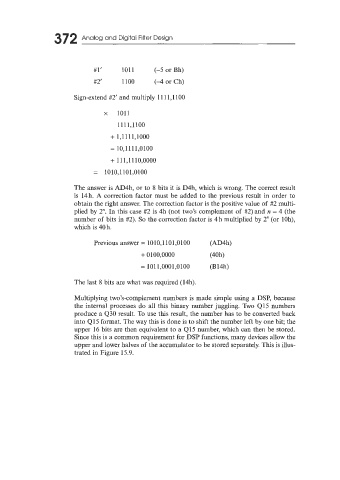
                             #1’      101 1     (-5  or Bh)

                             #2’      1100      (-4  or Ch)

                       Sign-extend #2’ and multiply 1 1 1 1,1100

                                x   1011
                                     1  1 1 1,1100
                                  + 1,1111,1000
                                  = 10,1111,0100

                                  + 111,1110,0000
                             =  1010,1101,0100

                       The answer is AD4h, or to 8 bits it is D4h, which is wrong. The correct result
                       is  14h. A correction factor must be  added to  the previous result in order to
                       obtain the right answer. The correction factor is the positive value of #2 multi-
                       plied by 2”. In this case #2 is 4h (not two’s complement of  #2) and n = 4 (the
                       number of bits in #2). So the correction factor is 4h multiplied by 2‘  (or lOh),
                       which is 40 h.

                             Previous answer = 1010,1101,0100    (AD4h)

                                            + 0100,0000          (40h)
                                            = 101 1,0001,0100    (B14h)

                       The last 8 bits are what was required (14h).

                       Multiplying two’s-complement numbers is made simple using a DSP, because
                       the internal processes do all this binary number juggling. Two Q15 numbers
                       produce a 430 result. To use this result, the number has to be converted back
                       into Q15 format. The way this is done is to shift the number left by one bit; the
                       upper  16 bits are then equivalent to a Q15 number, which can then be stored.
                       Since this is a common requirement for DSP functions, many devices allow the
                       upper and lower halves of the accumulator to be stored separately. This is illus-
                       trated in Figure 15.9.

