


Page 360 - Applied Process Design For Chemical And Petrochemical Plants Volume III
P. 360
66131_Ludwig_CH11A  5/30/2001 4:49 PM  Page 317


                                                                Refrigeration Systems                                      317

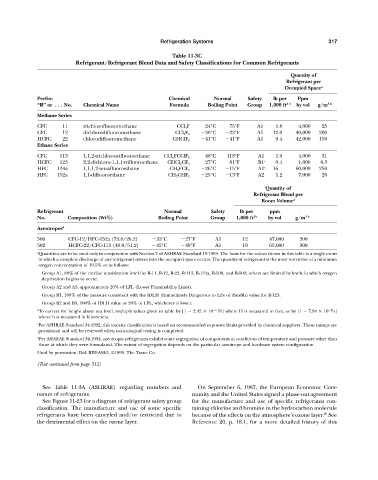
                                                                    Table 11-3C
                                   Refrigerant/Refrigerant Blend Data and Safety Classifications for Common Refrigerants
                                                                                                             Quantity of
                                                                                                            Refrigerant per
                                                                                                           Occupied Space a
                     Prefix:                                       Chemical        Normal      Safety  lb per   Ppm
                     “R” or  . . . No.  Chemical Name              Formula       Boiling Point  Group  1,000 ft 3 b  by vol  g/m 3 b
                     Methane Series
                     CFC      11     trichlorofluoromethane           CCl 3 F   24°C    75°F      A1    1.6     4,000   25
                     CFC      12     dichlorodifluoromethane         CCl 2 F 2   30°C   22°F      A1   12.0    40,000  200
                     HCFC     22     chlorodifluoromethane          CHClF 2    41°C     41°F      A1    9.4    42,000  150
                     Ethane Series
                     CFC     113     1,1,2-trichlorotrifluoroethane  CCl 2 FCClF 2  48°C  118°F   A1    1.9     4,000   31
                     HCFC    123     2,2-dichloro-1,1,1-trifluoroethane  CHCl 2 CF 3  27°C  81°F  B1 c  0.4     1,000   6.3
                     HFC    134a     1,1,1,2-tetrafluoroethane     CH 2 FCF 3   26°C    15°F      A1 c  16.0   60,000  250
                     HFC    152a     1,1-difluoroethane            CH 3 CHF 2   25°C    13°F      A2    1.2     7,000   20

                                                                                                     Quantity of
                                                                                                 Refrigerant Blend per
                                                                                                   Room Volume a
                     Refrigerant                                  Normal          Safety    lb per    ppm
                     No.        Composition (Wt%)              Boiling Point      Group    1,000 ft 3b  by vol  g/m 3 b

                     Azeotropes d
                     500        CFC-12/HFC-152a (73.8/26.2)   33°C      27°F       A1        12       47,000     200
                     502        HCFC-22/CFC-115 (48.8/51.2)   45°C      49°F       A1        19       65,000     300
                     a Quantities are to be used only in conjunction with Section 7 of ASHRAE Standard 15-1994. The basis for the values shown in this table is a single event
                      in which a complete discharge of any refrigerant system into the occupied space occurs. The quantity of refrigerant is the most restrictive of a minimum
                      oxygen concentration of 19.5% or as follows:
                       Group A1, 80% of the cardiac sensitization level for R-11, R-12, R-22, R-113, R-134a, R-500, and R-502; others are limited by levels in which oxygen
                       deprivation begins to occur.
                       Group A2 and A3, approximately 20% of LFL (Lower Flammability Limit).
                       Group B1, 100% of the measure consistent with the IDLH (Immediately Dangerous to Life or Health) value for R-123.
                       Group B2 and B3, 100% of IDLH value or 20% of LFL, whichever is lower.
                                                                                                                            2
                     b To correct for height above sea level, multiply values given in table by [1   2.42   10  6  H] where H is measured in feet, or by [1   7.94   10 h]
                      where h is measured in kilometers.
                     c Per ASHRAE Standard 34-1992, this toxicity classification is based on recommended exposure limits provided by chemical suppliers. These ratings are
                      provisional and will be reviewed when toxicological testing is completed.
                     d Per ASHRAE Standard 34-1992, azeotropic refrigerants exhibit some segregation of components at conditions of temperature and pressure other than
                      those at which they were formulated. The extent of segregation depends on the particular azeotrope and hardware system configuration.
                     Used by permission: Bul. REF-AM-3, ©1995. The Trane Co.
                     (Text continued from page 312)


                       See Table 11-3A (ASHRAE) regarding numbers and        On September 6, 1987, the European Economic Com-
                     names of refrigerants.                                munity and the United States signed a phase-out agreement
                       See Figure 11-23 for a diagram of refrigerant safety group  for the manufacture and use of specific refrigerants con-
                     classification. The manufacture and use of some specific  taining chlorine and bromine in the hydrocarbon molecule
                                                                                                                         20
                     refrigerants have been canceled and/or restricted due to  because of the effects on the atmosphere’s ozone layer. See
                     the detrimental effect on the ozone layer.            Reference 20, p. 18.1, for a more detailed history of this

