


Page 361 - Applied Process Design For Chemical And Petrochemical Plants Volume III
P. 361
66131_Ludwig_CH11A  5/30/2001 4:49 PM  Page 318


                       318                       Applied Process Design for Chemical and Petrochemical Plants

                                                                               Tables 11-9, 11-10, and 11-11 give useful comparative data
                                                                             for most of the common refrigerants.
                                                                               Pressure, temperature, and enthalpy or total heat values
                                                                             may be obtained from tables or diagrams covering each par-
                                                                             ticular refrigerant. Table 11-12 presents a few comparative
                                                                             values of boiling points (evaporator temperature) and cor-
                                                                             responding pressures as taken from such data.

                                                                             System Performance Comparison
                                                                               Table 11-13 is a study of the physical properties of several
                                                                             refrigerants indicating a common level of temperature oper-
                                                                             ation of 0°F evaporator operation and 110°F condensing
                                                                             temperature on the high pressure side. The comparison
                                                                             includes an approximate evaluation of the centrifugal and
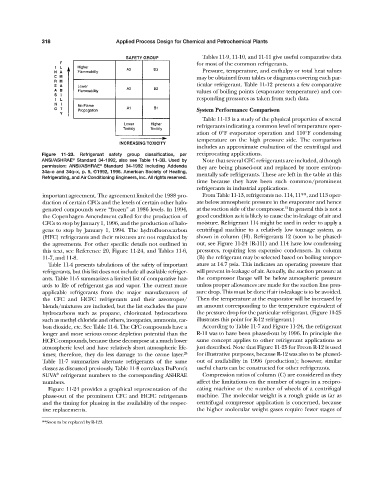
                       Figure 11-23.  Refrigerant safety group classification, per  reciprocating applications.
                       ANSI/ASHRAE Standard 34-1992, also see Table 11-3B. Used by  Note that several CFC refrigerants are included, although
                                  ®
                       permission: ANSI/ASHRAE Standard 34-1992 including Addenda  they are being phased-out and replaced by more environ-
                                           ®
                       34a–o and 34q–x, p. 5, ©1992, 1996. American Society of Heating,  mentally safe refrigerants. These are left in the table at this
                       Refrigerating, and Air Conditioning Engineers, Inc. All rights reserved.
                                                                             time because they have been such common/prominent
                                                                             refrigerants in industrial applications.
                       important agreement. The agreement limited the 1988 pro-  From Table 11-13, refrigerants no. 114, 11**, and 113 oper-
                       duction of certain CFCs and the levels of certain other halo-  ate below atmospheric pressure in the evaporator and hence
                                                                                                           12
                       genated compounds were “frozen” at 1986 levels. In 1994,  at the suction side of the compressor. In general this is not a
                       the Copenhagen Amendment called for the production of  good condition as it is likely to cause the in-leakage of air and
                       CFCs to stop by January 1, 1996, and the production of halo-  moisture. Refrigerant 114 might be used in order to apply a
                       gens to stop by January 1, 1994. The hydrofluorocarbon  centrifugal machine to a relatively low tonnage system, as
                       (HFC) refrigerants and their mixtures are not regulated by  shown in column (H). Refrigerants 12 (soon to be phased-
                       the agreements. For other specific details not outlined in  out, see Figure 11-24 [R-11]) and 114 have low condensing
                       this text, see Reference 20, Figure 11-24, and Tables 11-6,   pressures, requiring less expensive condensers. In column
                       11-7, and 11-8.                                       (B) the refrigerant may be selected based on boiling temper-
                         Table 11-4 presents tabulations of the safety of important  ature at 14.7 psia. This indicates an operating pressure that
                       refrigerants, but this list does not include all available refriger-  will prevent in-leakage of air. Actually, the suction pressure at
                       ants. Table 11-5 summarizes a limited list of comparative haz-  the compressor flange will be below atmospheric pressure
                       ards to life of refrigerant gas and vapor. The current more  unless proper allowances are made for the suction line pres-
                       applicable refrigerants from the major manufacturers of   sure drop. This must be done if air in-leakage is to be avoided.
                       the CFC and HCFC refrigerants and their azeotropes/   Then the temperature at the evaporator will be increased by
                       blends/mixtures are included, but the list excludes the pure  an amount corresponding to the temperature equivalent of
                       hydrocarbons such as propane, chlorinated hydrocarbons  the pressure drop for the particular refrigerant. (Figure 11-25
                       such as methyl chloride and others, inorganics, ammonia, car-  illustrates this point for R-12 refrigerant.)
                       bon dioxide, etc. See Table 11-6. The CFC compounds have a  According to Table 11-7 and Figure 11-24, the refrigerant
                       longer and more serious ozone depletion potential than the  R-11 was to have been phased-out by 1996. In principle the
                       HCFC compounds, because these decompose at a much lower  same concept applies to other refrigerant applications as
                       atmospheric level and have relatively short atmospheric life-  just described. Note that Figure 11-25 for Freon R-12 is used
                       times; therefore, they do less damage to the ozone layer. 28  for illustrative purposes, because R-12 was also to be phased-
                       Table 11-7 summarizes alternate refrigerants of the same  out of availability in 1996 (production); however, similar
                       classes as discussed previously. Table 11-8 correlates DuPont’s  useful charts can be constructed for other refrigerants.
                            ®
                       SUVA refrigerant numbers to the corresponding ASHRAE    Compression ratios of column (C) are considered as they
                       numbers.                                              affect the limitations on the number of stages in a recipro-
                         Figure 11-24 provides a graphical representation of the  cating machine or the number of wheels of a centrifugal
                       phase-out of the prominent CFC and HCFC refrigerants  machine. The molecular weight is a rough guide as far as
                       and the timing for phasing in the availability of the respec-  centrifugal compressor application is concerned, because
                       tive replacements.                                    the higher molecular weight gases require fewer stages of

                       **Soon to be replaced by R-123.

