


Page 396 - Applied Process Design For Chemical And Petrochemical Plants Volume III
P. 396
66131_Ludwig_CH11A  5/30/2001 4:50 PM  Page 353


                                                                Refrigeration Systems                                      353

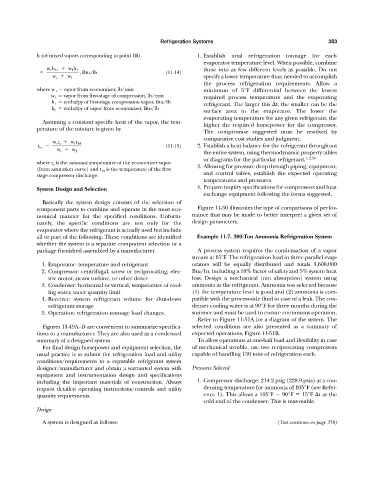
                     h (of mixed vapors corresponding to point 1B)           1. Establish total refrigeration tonnage for each
                                                                               evaporator temperature level. When possible, combine
                         w e h 1c      w 1 h 1                                 these into as few different levels as possible. Do not
                                    , Btu/lb                      (11-14)
                                                                               specify a lower temperature than needed to accomplish
                           w e      w 1
                                                                               the process refrigeration requirements. Allow a
                     where w  e   vapor from economizer, lb/min                minimum of 5°F differential between the lowest
                          w 1    vapor from first-stage of compression, lb/min  required process temperature and the evaporating
                          h 1    enthalpy of first-stage compression vapor, Btu/lb
                                                                               refrigerant. The larger this  t, the smaller can be the
                          h e    enthalpy of vapor from economizer, Btu/lb
                                                                               surface area in the evaporator. The lower the
                                                                               evaporating temperature for any given refrigerant, the
                       Assuming a constant specific heat of the vapor, the tem-
                                                                               higher the required horsepower for the compressor.
                     perature of the mixture is given by
                                                                               The compromise suggested must be resolved by
                                                                               comparative cost studies and judgment.
                           w e t e     w 1 t 1A
                      t m                                         (11-15)    2. Establish a heat balance for the refrigerant throughout
                            w e      w 1
                                                                               the entire system, using thermodynamic property tables
                                                                               or diagrams for the particular refrigerant. 1, 2, 20
                     where t e is the saturated temperature of the economizer vapor
                                                                             3. Allowing for pressure drop through piping, equipment,
                     (from saturation curve) and t 1A is the temperature of the first
                                                                               and control valves, establish the expected operating
                     stage compressor discharge.
                                                                               temperatures and pressures.
                                                                             4. Prepare inquiry specifications for compressors and heat
                     System Design and Selection
                                                                               exchange equipment following the forms suggested.
                       Basically the system design consists of the selection of
                     component parts to combine and operate in the most eco-  Figure 11-50 illustrates the type of comparisons of perfor-
                     nomical manner for the specified conditions. Unfortu-  mance that may be made to better interpret a given set of
                     nately, the specific conditions are not only for the  design parameters.
                     evaporator where the refrigerant is actually used but include
                     all or part of the following. These conditions are identified  Example 11-7. 300-Ton Ammonia Refrigeration System
                     whether the system is a separate component selection or a
                     package furnished assembled by a manufacturer.          A process system requires the condensation of a vapor
                                                                           stream at 15°F. The refrigeration load in three parallel evap-
                       1. Evaporator: temperature and refrigerant          orators will be equally distributed and totals 3,600,000
                       2. Compressor: centrifugal, screw or reciprocating; elec-  Btu/hr, including a 10% factor of safety and 5% system heat
                         tric motor, steam turbine, or other driver        loss. Design a mechanical (not absorption) system using
                       3. Condenser: horizontal or vertical, temperature of cool-  ammonia as the refrigerant. Ammonia was selected because
                         ing water, water quantity limit                   (1) the temperature level is good and (2) ammonia is com-
                       4. Receiver: system refrigerant volume for shut-down  patible with the process-side fluid in case of a leak. The con-
                         refrigerant storage                               denser cooling water is at 90°F for three months during the
                       5. Operation: refrigeration tonnage load changes.   summer and must be used to ensure continuous operation.
                                                                             Refer to Figure 11-51A for a diagram of the system. The
                       Figures 11-49A—D are convenient to summarize specifica-  selected conditions are also presented as a summary of
                     tions to a manufacturer. They are also used as a condensed  expected operations, Figure 11-51B.
                     summary of a designed system.                           To allow operations at one-half load and flexibility in case
                       For final design horsepower and equipment selection, the  of mechanical trouble, use two reciprocating compressors
                     usual practice is to submit the refrigeration load and utility  capable of handling 150 tons of refrigeration each.
                     conditions/requirements to a reputable refrigerant system
                     designer/manufacturer and obtain a warranted system with  Pressures Selected
                     equipment and instrumentation design and specifications
                     including the important materials of construction. Always  1. Compressor discharge: 214.2 psig (228.9 psia) at a con-
                     request detailed operating instructions/controls and utility  densing temperature for ammonia of 105°F (see Refer-
                     quantity requirements.                                    ence 1). This allows a 105°F   90°F   15°F  t at the
                                                                               cold end of the condenser. This is reasonable.
                     Design

                       A system is designed as follows:                                                  (Text continues on page 358)

