


Page 317 - Applied Photovoltaics
P. 317
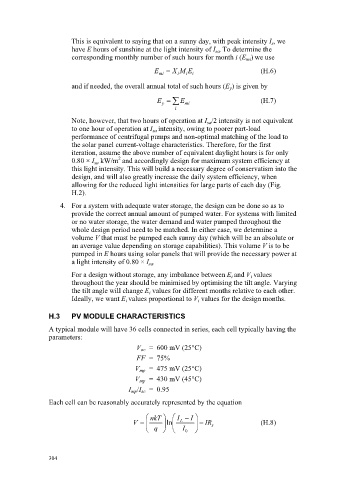
This is equivalent to saying that on a sunny day, with peak intensity I s , we
                            have E hours of sunshine at the light intensity of I sa . To determine the
                            corresponding monthly number of such hours for month i (E mi ) we use

                                                    E mi     X  i M i E i          (H.6)
                            and if needed, the overall annual total of such hours (E y ) is given by

                                                     E  y     ¦ E mi               (H.7)
                                                          i
                            Note, however, that two hours of operation at I sa /2 intensity is not equivalent
                            to one hour of operation at I sa intensity, owing to poorer part-load
                            performance of centrifugal pumps and non-optimal matching of the load to
                            the solar panel current-voltage characteristics. Therefore, for the first
                            iteration, assume the above number of equivalent daylight hours is for only
                                         2
                            0.80 × I sa  kW/m and accordingly design for maximum system efficiency at
                            this light intensity. This will build a necessary degree of conservatism into the
                            design, and will also greatly increase the daily system efficiency, when
                            allowing for the reduced light intensities for large parts of each day (Fig.
                            H.2).
                         4. For a system with adequate water storage, the design can be done so as to
                            provide the correct annual amount of pumped water. For systems with limited
                            or no water storage, the water demand and water pumped throughout the
                            whole design period need to be matched. In either case, we determine a
                            volume V that must be pumped each sunny day (which will be an absolute or
                            an average value depending on storage capabilities). This volume V is to be
                            pumped in E hours using solar panels that will provide the necessary power at
                            a light intensity of 0.80 × I sa .
                            For a design without storage, any imbalance between E i and V i values
                            throughout the year should be minimised by optimising the tilt angle. Varying
                            the tilt angle will change E i  values for different months relative to each other.
                            Ideally, we want E i values proportional to V i  values for the design months.

                     H.3    PV MODULE CHARACTERISTICS
                     A typical module will have 36 cells connected in series, each cell typically having the
                     parameters:
                                               V oc   =  600 mV (25°C)
                                               FF =  75%
                                              V mp =  475 mV (25°C)
                                              V mp   =  430 mV (45°C)
                                            I mp /I sc  =  0.95
                     Each cell can be reasonably accurately represented by the equation

                                                 §  nkT ·  I §     I ·
                                              V    ¨  ¸ln ¨  L  ¸     IR           (H.8)
                                                 ¨    ¸  ¨      ¸   s
                                                 ©  q  ¹  ©  I  0  ¹


                     304

