


Page 316 - Applied Photovoltaics
P. 316
where X i and Y i represent the fraction of sunny and cloudy days, respectively.
                                 For a directly-coupled system, we make the assumption that no pumping
                                 takes place during cloudy weather because of poor sub-system performance in
                                 the presence of greatly reduced operating currents. We therefore use the
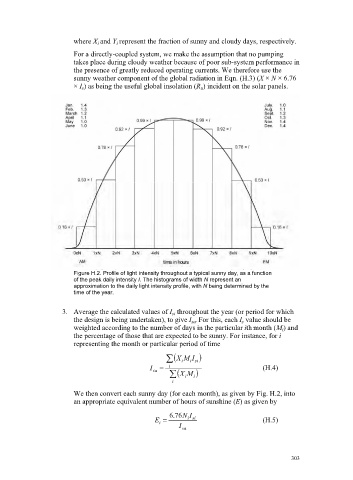
                                 sunny weather component of the global radiation in Eqn. (H.3) (X × N × 6.76
                                 × I s ) as being the useful global insolation (R u ) incident on the solar panels.


                                 Figure H.2. Profile of light intensity throughout a typical sunny day, as a function
                                 of the peak daily intensity I. The histograms of width N represent an
                                 approximation to the daily light intensity profile, with N being determined by the
                                 time of the year.

                              3. Average the calculated values of I si  throughout the year (or period for which
                                 the design is being undertaken), to give I sa . For this, each I s  value should be
                                 weighted according to the number of days in the particular ith month (M i ) and
                                 the percentage of those that are expected to be sunny. For instance, for i
                                 representing the month or particular period of time
                                                            ¦    i M i I si  X
                                                       I     i                          (H.4)
                                                        sa
                                                                 ¦  i M i  X
                                                             i
                                 We then convert each sunny day (for each month), as given by Fig. H.2, into
                                 an appropriate equivalent number of hours of sunshine (E) as given by

                                                              . 6  76 N  I
                                                        E         i  si                 (H.5)
                                                          i
                                                               I
                                                                sa


                                                                                                303

