


Page 311 - Applied Photovoltaics
P. 311
where Ș mppt  is the MPPT efficiency (typically 95%).
                     Therefore
                                               Ș in   =  0.0975 × 0.85 × 0.95 × 0.90
                                                  = 0.071
                     and, from Eqn. (G.3)
                                                A  =  5000/(4300 × 0.071 × 0.72)
                                                  = 22.8 m 2

                     or, in terms of the manufacturer’s ratings (at 25°C)
                                                             2
                                        array  rating  = 1000 W/m  × 0.10 × 22.8 m 2
                                                  = 2.28 kW p .

                     This compares to the 3.0 kW p  rating required without the MPPT. A trade off
                     obviously exists between cost, system complexity, system efficiency and reliability.
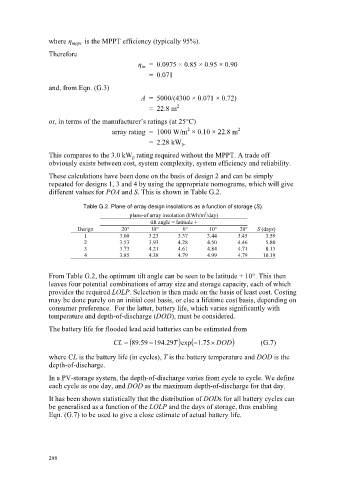
                     These calculations have been done on the basis of design 2 and can be simply
                     repeated for designs 1, 3 and 4 by using the appropriate nomograms, which will give
                     different values for POA and S. This is shown in Table G.2.

                               Table G.2. Plane-of-array design insolations as a function of storage (S).
                                                                  2
                                             plane-of array insolation (kWh/m /day)
                                                   tilt angle = latitude +
                              Design     –20°     –10°      0°      10°     20°   S (days)
                               1          3.00    3.23     3.37    3.44     3.45    3.59
                               2          3.53    3.93     4.28    4.50     4.46    5.80
                               3          3.73    4.21     4.61    4.84     4.71    8.13
                               4          3.85    4.38     4.79    4.99     4.79   10.19

                     From Table G.2, the optimum tilt angle can be seen to be latitude + 10°. This then
                     leaves four potential combinations of array size and storage capacity, each of which
                     provides the required LOLP. Selection is then made on the basis of least cost. Costing
                     may be done purely on an initial cost basis, or else a lifetime cost basis, depending on
                     consumer preference.  For the latter, battery life, which varies significantly with
                     temperature and depth-of-discharge (DOD), must be considered.
                     The battery life for flooded lead acid batteries can be estimated from

                                        CL   89  59    . 29 T    .     194    75  u  DOD   exp  (G.7)
                                                                1
                                                                 .
                     where CL is the battery life (in cycles), T is the battery temperature and DOD is the
                     depth-of-discharge.
                     In a PV-storage system, the depth-of-discharge varies from cycle to cycle. We define
                     each cycle as one day, and DOD as the maximum depth-of-discharge for that day.

                     It has been shown statistically that the distribution of DODs for all battery cycles can
                     be generalised as a function of the LOLP and the days of storage, thus enabling
                     Eqn. (G.7) to be used to give a close estimate of actual battery life.


                     298

