


Page 306 - Applied Photovoltaics
P. 306
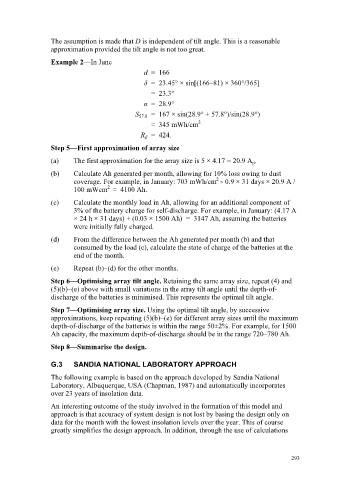
The assumption is made that D is independent of tilt angle. This is a reasonable
                          approximation provided the tilt angle is not too great.
                          Example 2—In June
                                                     d = 166
                                                     į  =  23.45° × sin[(166–81) × 360°/365]
                                                       = 23.3°
                                                     Į  =  28.9°
                                                   S 57.8  =  167 × sin(28.9° + 57.8°)/sin(28.9°)
                                                       = 345 mWh/cm  2
                                                    R ȕ = 424.
                          Step 5—First approximation of array size

                          (a)    The first approximation for the array size is 5 × 4.17 = 20.9 A p .
                          (b)    Calculate Ah generated per month, allowing for 10% loss owing to dust
                                                                          2
                                 coverage. For example, in January: 703 mWh/cm  × 0.9 × 31 days × 20.9 A /
                                           2
                                 100 mWcm =  4100 Ah.
                          (c)    Calculate the monthly load in Ah, allowing for an additional component of
                                 3% of the battery charge for self-discharge. For example, in January: (4.17 A
                                 × 24 h × 31 days) + (0.03 × 1500 Ah)  =  3147 Ah, assuming the batteries
                                 were initially fully charged.
                          (d)    From the difference between the Ah generated per month (b) and that
                                 consumed by the load (c), calculate the state of charge of the batteries at the
                                 end of the month.
                          (e)    Repeat (b)–(d) for the other months.

                          Step 6—Optimising array tilt angle. Retaining the same array size, repeat (4) and
                          (5)(b)–(e) above with small variations in the array tilt angle until the depth-of-
                          discharge of the batteries is minimised. This represents the optimal tilt angle.

                          Step 7—Optimising array size. Using the optimal tilt angle, by successive
                          approximations, keep repeating (5)(b)–(e) for different array sizes until the maximum
                          depth-of-discharge of the batteries is within the range 50±2%. For example, for 1500
                          Ah capacity, the maximum depth-of-discharge should be in the range 720–780 Ah.
                          Step 8—Summarise the design.

                          G.3    SANDIA  NATIONAL    LABORATORY APPROACH

                          The following example is based on the approach developed by Sandia National
                          Laboratory, Albuquerque, USA (Chapman, 1987) and automatically incorporates
                          over 23 years of insolation data.
                          An interesting outcome of the study involved in the formation of this model and
                          approach is that accuracy of system design is not lost by basing the design only on
                          data for the month with the lowest insolation levels over the year. This of course
                          greatly simplifies the design approach. In addition, through the use of calculations


                                                                                                293

