


Page 309 - Applied Photovoltaics
P. 309
Step 3—Determine array size for each of the four designs
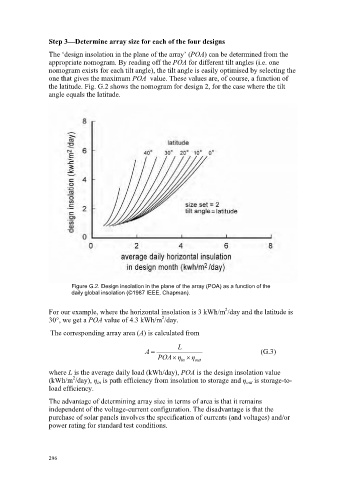
                     The ‘design insolation in the plane of the array’ (POA) can be determined from the
                     appropriate nomogram. By reading off the POA for different tilt angles (i.e. one
                     nomogram exists for each tilt angle), the tilt angle is easily optimised by selecting the
                     one that gives the maximum POA  value. These values are, of course, a function of
                     the latitude. Fig. G.2 shows the nomogram for design 2, for the case where the tilt
                     angle equals the latitude.


                            Figure G.2. Design insolation in the plane of the array (POA) as a function of the
                            daily global insolation (©1987 IEEE, Chapman).

                                                                        2
                     For our example, where the horizontal insolation is 3 kWh/m /day and the latitude is
                                                      2
                     30°, we get a POA value of 4.3 kWh/m /day.
                      The corresponding array area (A) is calculated from
                                                           L
                                                 A                                 (G.3)
                                                     POAu  Ș u  Ș
                                                           in  out
                     where L is the average daily load (kWh/day), POA is the design insolation value
                            2
                     (kWh/m /day), Ș in  is path efficiency from insolation to storage and Ș out  is storage-to-
                     load efficiency.
                     The advantage of determining array size in terms of area is that it remains
                     independent of the voltage-current configuration. The disadvantage is that the
                     purchase of solar panels involves the specification of currents (and voltages) and/or
                     power rating for standard test conditions.


                     296

