


Page 305 - Applied Photovoltaics
P. 305
Step 2—Select battery capacity. For the above load and allowing for 15 days of
                     battery storage, we require a battery capacity of
                                          4.17 A × 24 h × 15 days = 1500 Ah.
                     Step 3—First approximation of tilt angle.  This is based on site information and
                     usually involves selecting a tilt angle 20° greater than the latitude. For example, for
                     Melbourne, which is at latitude 37.8°S, the first approximation for tilt angle is latitude
                     + 20° = 57.8°.
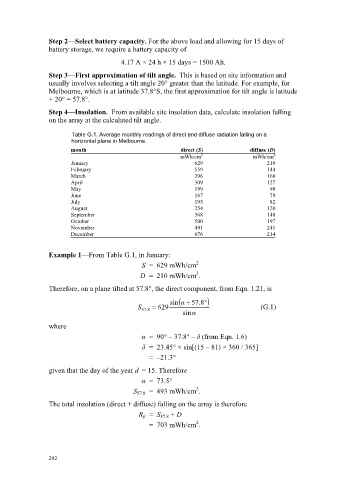
                     Step 4—Insolation.  From available site insolation data, calculate insolation falling
                     on the array at the calculated tilt angle.

                            Table G.1. Average monthly readings of direct and diffuse radiation falling on a
                            horizontal plane in Melbourne.
                            month                          direct (S)          diffuse (D)
                                                           mWh/cm 2             mWh/cm 2
                            January                            629                  210
                            February                           559                  144
                            March                              396                  166
                            April                              309                  127
                            May                                199                   98
                            June                               167                   79
                            July                               195                   82
                            August                             254                  120
                            September                          368                  148
                            October                            500                  197
                            November                           491                  241
                            December                           676                  214


                     Example 1—From Table G.1, in January:
                                                S = 629 mWh/cm  2
                                                                2
                                                D = 210 mWh/cm .
                     Therefore, on a plane tilted at 57.8°, the direct component, from Eqn. 1.21, is
                                                        sin       8 .   Į 57 q
                                               S      629                          (G.1)
                                                57  8 .
                                                            sin Į
                     where
                                                Į =  90° – 37.8° – į (from Eqn. 1.6)
                                                į  =  23.45° × sin[(15 – 81) × 360 / 365]
                                                  = –21.3°

                     given that the day of the year d  = 15. Therefore
                                                Į =  73.5°
                                                                2
                                              S 57.8 = 493 mWh/cm .
                     The total insolation (direct + diffuse) falling on the array is therefore
                                               R ȕ   = S 57.8  + D
                                                                2
                                                  = 703 mWh/cm .


                     292

