


Page 310 - Applied Photovoltaics
P. 310
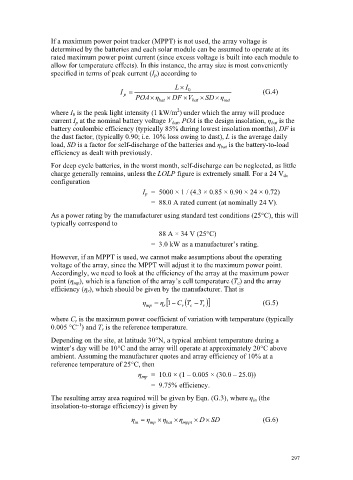
If a maximum power point tracker (MPPT) is not used, the array voltage is
                          determined by the batteries and each solar module can be assumed to operate at its
                          rated maximum power point current (since excess voltage is built into each module to
                          allow for temperature effects). In this instance, the array size is most conveniently
                          specified in terms of peak current (I p ) according to
                                                              L u  I
                                              I                   0                     (G.4)
                                               p
                                                   POAu  Ș  u  DF u V  u  SD u  Ș
                                                         bat       bat      out
                                                               2
                          where I 0  is the peak light intensity (1 kW/m ) under which the array will produce
                          current I p  at the nominal battery voltage V bat , POA is the design insolation, Ș bat  is the
                          battery coulombic efficiency (typically 85% during lowest insolation months), DF is
                          the dust factor, (typically 0.90; i.e. 10% loss owing to dust), L is the average daily
                          load, SD is a factor for self-discharge of the batteries and Ș bat  is the battery-to-load
                          efficiency as dealt with previously.

                          For deep cycle batteries, in the worst month, self-discharge can be neglected, as little
                          charge generally remains, unless the LOLP figure is extremely small. For a 24 V dc
                          configuration
                                                     I p =  5000 × 1 / (4.3 × 0.85 × 0.90 × 24 × 0.72)
                                                        =  88.0 A rated current (at nominally 24 V).

                          As a power rating by the manufacturer using standard test conditions (25°C), this will
                          typically correspond to
                                                          88 A × 34 V (25°C)
                                                        =  3.0 kW as a manufacturer’s rating.
                          However, if an MPPT is used, we cannot make assumptions about the operating
                          voltage of the array, since the MPPT will adjust it to the maximum power point.
                          Accordingly, we need to look at the efficiency of the array at the maximum power
                          point (Ș mp ), which is a function of the array’s cell temperature (T c ) and the array
                          efficiency (Ș r ), which should be given by the manufacturer. That is
                                                     Ș     Ș 1  C   >  T   T    @       (G.5)
                                                      mp   r    r  c  r
                          where C r  is the maximum power coefficient of variation with temperature (typically
                                  –1
                          0.005 °C ) and T r  is the reference temperature.
                          Depending on the site, at latitude 30°N, a typical ambient temperature during a
                          winter’s day will be 10°C and the array will operate at approximately 20°C above
                          ambient. Assuming the manufacturer quotes and array efficiency of 10% at a
                          reference temperature of 25°C, then
                                                    Ș mp   =  10.0 × (1 – 0.005 × (30.0 – 25.0))
                                                        =  9.75% efficiency.

                          The resulting array area required will be given by Eqn. (G.3), where Ș in  (the
                          insolation-to-storage efficiency) is given by
                                                  Ș    Ș  u Ș  u  Ș  u  D u  SD         (G.6)
                                                   in  mp   bat  mppt


                                                                                                297

