


Page 320 - Applied Statistics And Probability For Engineers
P. 320
c08.qxd  5/15/02  6:13 PM  Page 272 RK UL 6 RK UL 6:Desktop Folder:TEMP WORK:MONTGOMERY:REVISES UPLO D CH114 FIN L:Quark Files:


               272     CHAPTER 8 STATISTICAL INTERVALS FOR A SINGLE SAMPLE


                          Supplemental Exercises                   99
               8-70.  Consider the confidence interval for   with known  95
                                                                   90
               standard deviation  :
                                                                   80
                                                                   70
                                               	 1n
                        x   z   1   	 1n     x   z   2             60
                                                                  Percentage  50
               where   1    2   . Let    0.05 and find the interval for  40
                 1    2    2   0.025. Now find the interval for the case
                                                                   30
                 1   0.01 and   2   0.04. Which interval is shorter? Is there
                                                                   20
               any advantage to a “symmetric” confidence interval?
                                                                   10
               8-71.  A normal population has a known mean 50 and
                                                                    5
               unknown variance.
               (a) A random sample of n   16 is selected from this popula-
                                                                    1
                  tion, and the sample results are    52 and s   8. How
                                         x
                  unusual are these results? That is, what is the probability  13.5  14.0  14.5  15.0  15.5  16.0  16.5  17.0
                  of observing a sample average as large as 52 (or larger) if    Hemoglobin Level
                  the known, underlying mean is actually 50?
               (b) A random sample of n   30 is selected from this popula-
                                         x
                  tion, and the sample results are    52 and s   8. How
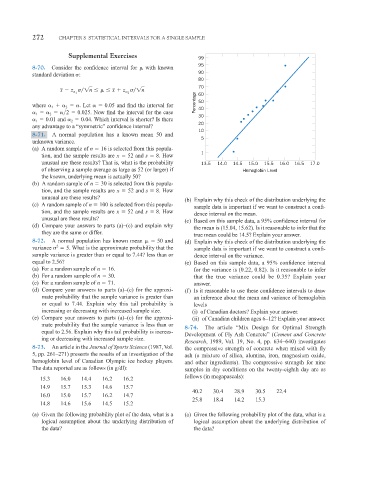
                  unusual are these results?                   (b) Explain why this check of the distribution underlying the
               (c) A random sample of n   100 is selected from this popula-  sample data is important if we want to construct a confi-
                                         x
                  tion, and the sample results are    52 and s   8. How  dence interval on the mean.
                  unusual are these results?                   (c) Based on this sample data, a 95% confidence interval for
               (d) Compare your answers to parts (a)–(c) and explain why  the mean is (15.04, 15.62). Is it reasonable to infer that the
                  they are the same or differ.                    true mean could be 14.5? Explain your answer.
               8-72.  A normal population has known mean    50 and  (d) Explain why this check of the distribution underlying the
                      2
               variance     5. What is the approximate probability that the  sample data is important if we want to construct a confi-
               sample variance is greater than or equal to 7.44? less than or  dence interval on the variance.
               equal to 2.56?                                  (e) Based on this sample data, a 95% confidence interval
               (a) For a random sample of n   16.                 for the variance is (0.22, 0.82). Is it reasonable to infer
               (b) For a random sample of n   30.                 that the true variance could be 0.35? Explain your
               (c) For a random sample of n   71.                 answer.
               (d) Compare your answers to parts (a)–(c) for the approxi-  (f) Is it reasonable to use these confidence intervals to draw
                  mate probability that the sample variance is greater than  an inference about the mean and variance of hemoglobin
                  or equal to 7.44. Explain why this tail probability is  levels
                  increasing or decreasing with increased sample size.  (i) of Canadian doctors? Explain your answer.
               (e) Compare your answers to parts (a)–(c) for the approxi-  (ii) of Canadian children ages 6–12? Explain your answer.
                  mate probability that the sample variance is less than or  8-74.  The article  “Mix Design for Optimal Strength
                  equal to 2.56. Explain why this tail probability is increas-  Development of Fly Ash Concrete” (Cement and Concrete
                  ing or decreasing with increased sample size.
                                                               Research, 1989, Vol. 19, No. 4, pp. 634–640) investigates
               8-73.  An article in the Journal of Sports Science (1987, Vol.  the compressive strength of concrete when mixed with fly
               5, pp. 261–271) presents the results of an investigation of the  ash (a mixture of silica, alumina, iron, magnesium oxide,
               hemoglobin level of Canadian Olympic ice hockey players.  and other ingredients). The compressive strength for nine
               The data reported are as follows (in g/dl):     samples in dry conditions on the twenty-eighth day are as
                 15.3   16.0  14.4   16.2  16.2                follows (in megapascals):
                 14.9   15.7  15.3   14.6  15.7
                                                                 40.2   30.4  28.9   30.5   22.4
                 16.0   15.0  15.7   16.2  14.7
                                                                 25.8   18.4  14.2   15.3
                 14.8   14.6  15.6   14.5  15.2
               (a) Given the following probability plot of the data, what is a  (a) Given the following probability plot of the data, what is a
                  logical assumption about the underlying distribution of  logical assumption about the underlying distribution of
                  the data?                                       the data?

