


Page 589 - Battery Reference Book
P. 589
Nickel-cadmium secondary batteries  51/27

          1.4 r
        7   1.3
        7  1.3
        I
        I
        &   1.2
        &  1.2
        m
        m
        -
        -
        I
        I
        p
        p  1.1
        -  -  1.1
        -
        -
        8   1.0
        8  1.0
          0.9
          0.9
                    3
            0  0   1 1  2 2  3   4  4   5  5   6  6   7   8   9101112
                               7  8
                                    9101112
                                                           I  l  l  l  l  l  l  l  l  l  l  l
                       Discharge time (h)              14  15  16  17  18  19  20  21  22  23  24  25  26
          1.4                                                       Charging time (h)
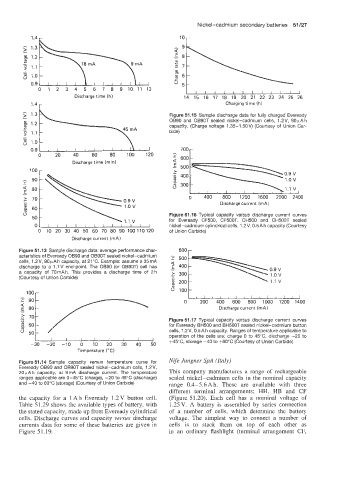
                                                   Figure 51.15  Sample discharge data for fully charged Eveready
                                                   OB90 and  OB90T sealed  nickel-cadmium  cells,  1.2V,  90uAh
                                                   capacity.  (Charge voltage  1.35-1.5Ov)  (Courtesy of  Union Car-
                                                   bide)
          0.9 0 L 20   40   60   80    100            700
          !.O
                                        A120
                                                    .
                                                    ' 600r
                                                    A
                      Discharge time bin)
                                                    E  500
          100 r                                     c
                                                    >
                                                    'p  400
                                                    a
                                                    ;
                                                      300
                                                         0   400   800   1200   1600   2000  2400
                                                                  Discharge current  (mA)
        -  Y"
                                                   Figure 51.16  Typical  capacity  versus  discharge  current  curves
        ' 501                         ...          for  Eveready  CF500,  CFSOOT,  CH500  and  CH500T  sealed
           0L-f      1   1  1  I   I   1  1  1   ~   I   I   nickel-cadmium  cylindrical cells, 1.2V, 0.5A h capacity (Courtesy
            0  10  20  30  40  50  60  70  80  90  100 110120   of Union Carbide)
                      Discharge current  (mA)
       Figure 51.13  Sample discharge data: average performance char-   600 r
       acteristics of Eveready OB90 and OB90T sealed nickel-cadmium   500
       cells, 1.2 V, 90 pA h capacity, at 21 "C. Example: assume a 35 mA
       discharge to a  1.1 V  end-point.  The  OB90  (or OB9OT) cell  has   2  400   0.9 v
       a  capacity  of  70 rnA h.  This  provides  a  discharge  time  of  2 h   1   1.0 v
                                                    .- ,Z  300
       (Courtesy of Union Carbide)
                                                      200                        1.1 v
                                                    -
         1OOr
                                                       0    200   400   600   800   1000  1200  1400
                                                                  Discharge current  (mA)
                                                   Figure  51.17  Typical  capacity  versus  discharge  current  curves
                                                   for Eveready BH500 and BHSOOT sealed nickel-cadmium  button
                                                   cells, 1.2V, 0.5A h capacity. Ranges of temperature applicable to
                                                   operation of  the  cells are:  charge 0 to 45"C,  discharge -20  to
                I    I   I   I   I   I    I   J    +45"C,  storage -40  to +60"C  (Courtesy of Union Carbide)
          -30   -20   -10   0   10   20   30   40   50
                        Temperature ("C)
       Figure 51.14  Sample  capacity  versus  temperature  curve  for   N$e  Jungner SPA (Italy)
       Eveready OB90 and OB90T sealed nickel-cadmium  cells, 1.2 V,
       20sAh capacity,  at  9 mA  discharge  current.  The  temperature   This  company manufactures  a range  of  rechargeable
       ranges applicable are 0-45°C  (charge), -20  to 45°C (discharge)   sealed nickel-cadmium  cells in the nominal capacity
       and -40  to 60°C (storage) (Courtesy of Union Carbide)   range  0.4-5.6Ah.  These  are  available  with  three
                                                   different  terminal  arrangements;  HH,  HB  and  CF
       the  capacity  for  a  1 Ah  Eveready  1.2V button  cell.   (Figure 51.20).  Each  cell  has  a  nomind  voltage  of
       Table 51.29 shows the available types of battery, with   1.25 V.  A  battery  is  assembled by  series  connection
       the stated capacity, made up from Eveready cylindrical   of  a  number  of  cells,  which  determine  the  battery
       cells. Discharge curves and capacity versus  discharge   voltage.  The  simplest  way  to  connect  a  number  of
       currents data for some of  these batteries are given in   cells  is  to  stack  them  on  top  of  each  other  as
       Figure 51.19.                               in  an  ordinary  flashlight  (terminal  arrangement  CF,

