


Page 178 - Bebop to The Boolean Boogie An Unconventional Guide to Electronics Fundamentals, Components, and Processes
P. 178
Integrated  Circuits (ICs)   159

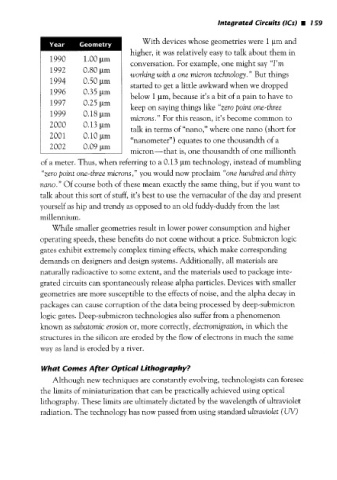
                                           With devices whose geometries were 1 pm and
                                       higher, it was relatively easy to talk about them in
                1990      1.00 pm       conversation. For example, one might say “I’m
                1992      0.80 pm       working with a one micron technology. ” But things
                1991      0.50 pm       started to get a little awkward when we dropped
                1996      0.35 pm      below 1 pm, because it’s a bit of a pain to have to
                1999      0.25 pm      keep on saying things like “zero point one-three
                1999      0.18 pm       microns.” For this reason, it’s become common to
                2000      0.13 pm       talk in terms of  “nano,” where one nano (short for
                2001      0.10 pm       “nanometer”) equates to one thousandth of a
                2002      0.09 pm
                                        micron-that   is, one thousandth of one millionth
             of a meter. Thus, when referring to a 0.13 pm technology, instead of mumbling
             “zero point one-three microns,” you would now proclaim “one hundred and thirty
             nuno.” Of course both of these mean exactly the same thing, but if you want to
             talk about this sort of stuff, it’s best to use the vernacular of the day and present
             yourself as hip and trendy as opposed to an old fuddy-duddy from the last
             millennium.
                 While smaller geometries result in lower power consumption and higher
             operating speeds, these benefits do not come without a price. Submicron logic
             gates exhibit extremely complex timing effects, which make corresponding
             demands on designers and design systems. Additionally, all materials are
             naturally radioactive to some extent, and the materials used to package inte-
             grated circuits can spontaneously release alpha particles. Devices with smaller
             geometries are more susceptible to the effects of noise, and the alpha decay in
             packages can cause corruption of the data being processed by deep-submicron
             logic gates. Deep-submicron technologies also suffer from a phenomenon
             known as subatomic erosion or, more correctly, electromigration, in which the
             structures in the silicon are eroded by the flow of electrons in much the same

             way as land is eroded by a river.

              What Comes After  Optical Lithography?
                 Although new techniques are constantly evolving, technologists can foresee
             the limits of  miniaturization that can be practically achieved using optical
             lithography. These limits are ultimately dictated by the wavelength of ultraviolet
             radiation. The technology has now passed from using standard ultraviolet (UV)

