


Page 175 - Bebop to The Boolean Boogie An Unconventional Guide to Electronics Fundamentals, Components, and Processes
P. 175
156    Chapter Fourteen

                         1945  1950  1955  1960 1965  1970  1975  1900 1905  1990 1995 2000

                   FPGAs
                     PLDs

                    A5ICs
          Microprocessors
         SRAMs & DRAM5
             ICs (General)

               Transistors


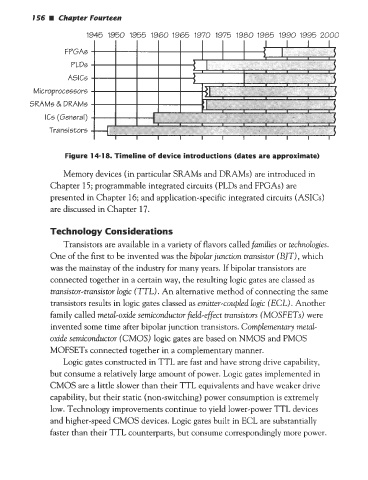
                   Figure 14-1 8. Timeline of device introductions (dates are approximate)

                  Memory devices (in particular SRAMs and DRAMS) are introduced in
               Chapter 15; programmable integrated circuits (PLDs and FPGAs) are
               presented in Chapter 16; and application-specific integrated circuits ( ASICs)
               are discussed in Chapter 17.


               Technology Considerations
                  Transistors are available in a variety of flavors called families or technologies.
               One of the first to be invented was the bipolar junction transistor (BJT) , which
               was the mainstay of the industry for many years. If bipolar transistors are
               connected together in a certain way, the resulting logic gates are classed as
               transistor-transistor logic (TTL). An alternative method of connecting the same
               transistors results in logic gates classed as emitter-coupled logic (ECL). Another
               family called metal-oxide semiconductor field-effect transistors (MOSFETs) were
               invented some time after bipolar junction transistors. Complementary metal-
               oxide semiconductor (CMOS) logic gates are based on NMOS and PMOS
               MOFSETs connected together in a complementary manner.
                  Logic gates constructed in TTL are fast and have strong drive capability,
               but consume a relatively large amount of power. Logic gates implemented in
               CMOS are a little slower than their TTL equivalents and have weaker drive
               capability, but their static (non-switching) power consumption is extremely
               low. Technology improvements continue to yield lower-power TTL devices
               and higher-speed CMOS devices. Logic gates built in ECL are substantially
               faster than their TTL counterparts, but consume correspondingly more power.

