


Page 177 - Berkshire Encyclopedia Of World History Vol I - Abraham to Coal
P. 177
62 berkshire encyclopedia of world history


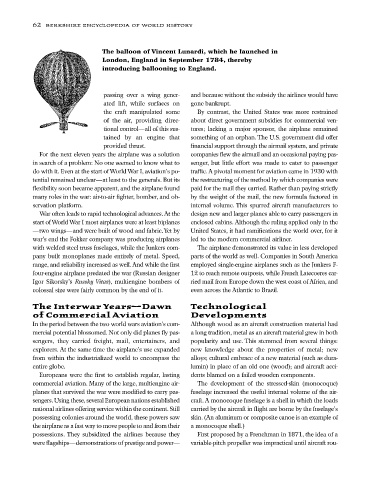
                                   The balloon of Vincent Lunardi, which he launched in
                                   London, England in September 1784, thereby
                                   introducing ballooning to England.


                                   passing over a wing gener-   and because without the subsidy the airlines would have
                                   ated lift, while surfaces on   gone bankrupt.
                                   the craft manipulated some     By contrast, the United States was more restrained
                                   of the air, providing direc-  about direct government subsidies for commercial ven-
                                   tional control—all of this sus-  tures; lacking a major sponsor, the airplane remained
                                   tained by an engine that     something of an orphan.The U.S. government did offer
                                   provided thrust.             financial support through the airmail system, and private
              For the next eleven years the airplane was a solution  companies flew the airmail and an occasional paying pas-
            in search of a problem: No one seemed to know what to  senger, but little effort was made to cater to passenger
            do with it. Even at the start of World War I, aviation’s po-  traffic.A pivotal moment for aviation came in 1930 with
            tential remained unclear—at least to the generals. But its  the restructuring of the method by which companies were
            flexibility soon became apparent, and the airplane found  paid for the mail they carried. Rather than paying strictly
            many roles in the war: air-to-air fighter, bomber, and ob-  by the weight of the mail, the new formula factored in
            servation platform.                                 internal volume. This spurred aircraft manufacturers to
              War often leads to rapid technological advances.At the  design new and larger planes able to carry passengers in
            start of World War I most airplanes were at least biplanes  enclosed cabins. Although the ruling applied only in the
            —two wings—and were built of wood and fabric.Yet by  United States, it had ramifications the world over, for it
            war’s end the Fokker company was producing airplanes  led to the modern commercial airliner.
            with welded steel truss fuselages, while the Junkers com-  The airplane demonstrated its value in less developed
            pany built monoplanes made entirely of metal. Speed,  parts of the world as well. Companies in South America
            range, and reliability increased as well.And while the first  employed single-engine airplanes such as the Junkers F-
            four-engine airplane predated the war (Russian designer  12 to reach remote outposts, while French Latecoeres car-
            Igor Sikorsky’s Russky Vitaz), multiengine bombers of  ried mail from Europe down the west coast of Africa, and
            colossal size were fairly common by the end of it.  even across the Atlantic to Brazil.


            The Interwar Years—Dawn                             Technological
            of Commercial Aviation                              Developments
            In the period between the two world wars aviation’s com-  Although wood as an aircraft construction material had
            mercial potential blossomed. Not only did planes fly pas-  a long tradition, metal as an aircraft material grew in both
            sengers, they carried freight, mail, entertainers, and  popularity and use. This stemmed from several things:
            explorers. At the same time the airplane’s use expanded  new knowledge about the properties of metal; new
            from within the industrialized world to encompass the  alloys; cultural embrace of a new material (such as dura-
            entire globe.                                       lumin) in place of an old one (wood); and aircraft acci-
              Europeans were the first to establish regular, lasting  dents blamed on a failed wooden components.
            commercial aviation. Many of the large, multiengine air-  The development of the stressed-skin (monocoque)
            planes that survived the war were modified to carry pas-  fuselage increased the useful internal volume of the air-
            sengers.Using these,several European nations established  craft.A monocoque fuselage is a shell in which the loads
            national airlines offering service within the continent.Still  carried by the aircraft in flight are borne by the fuselage’s
            possessing colonies around the world, these powers saw  skin. (An aluminum or composite canoe is an example of
            the airplane as a fast way to move people to and from their  a monocoque shell.)
            possessions. They subsidized the airlines because they  First proposed by a Frenchman in 1871, the idea of a
            were flagships—demonstrations of prestige and power—  variable-pitch propeller was impractical until aircraft rou-

