


Page 178 - Berkshire Encyclopedia Of World History Vol I - Abraham to Coal
P. 178
airplane 63


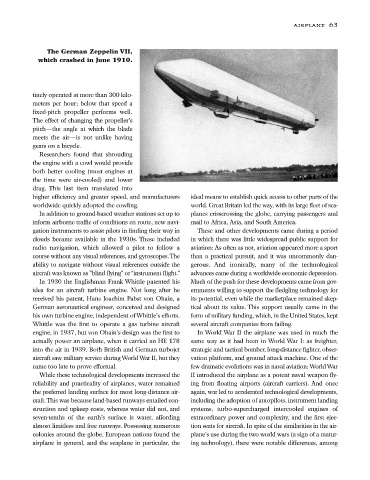
                 The German Zeppelin VII,
              which crashed in June 1910.


            tinely operated at more than 300 kilo-
            meters per hour; below that speed a
            fixed-pitch propeller performs well.
            The effect of changing the propeller’s
            pitch—the angle at which the blade
            meets the air—is not unlike having
            gears on a bicycle.
              Researchers found that shrouding
            the engine with a cowl would provide
            both better cooling (most engines at
            the time were air-cooled) and lower
            drag. This last item translated into
            higher efficiency and greater speed, and manufacturers  ideal means to establish quick access to other parts of the
            worldwide quickly adopted the cowling.              world. Great Britain led the way, with its large fleet of sea-
              In addition to ground-based weather stations set up to  planes crisscrossing the globe, carrying passengers and
            inform airborne traffic of conditions en route, new navi-  mail to Africa, Asia, and South America.
            gation instruments to assist pilots in finding their way in  These and other developments came during a period
            clouds became available in the 1930s. These included  in which there was little widespread public support for
            radio navigation, which allowed a pilot to follow a  aviation: As often as not, aviation appeared more a sport
            course without any visual references, and gyroscopes.The  than a practical pursuit, and it was uncommonly dan-
            ability to navigate without visual references outside the  gerous. And ironically, many of the technological
            aircraft was known as ”blind flying” or “instrument flight.”  advances came during a worldwide economic depression.
              In 1930 the Englishman Frank Whittle patented his  Much of the push for these developments came from gov-
            idea for an aircraft turbine engine. Not long after he  ernments willing to support the fledgling technology for
            received his patent, Hans Joachim Pabst von Ohain, a  its potential, even while the marketplace remained skep-
            German aeronautical engineer, conceived and designed  tical about its value. This support usually came in the
            his own turbine engine, independent of Whittle’s efforts.  form of military funding, which, in the United States, kept
            Whittle was the  first to operate a gas turbine aircraft  several aircraft companies from failing.
            engine, in 1937, but von Ohain’s design was the first to  In World War II the airplane was used in much the
            actually power an airplane, when it carried an HE 178  same way as it had been in World War I: as freighter,
            into the air in 1939. Both British and German turbojet  strategic and tactical bomber, long-distance fighter, obser-
            aircraft saw military service during World War II, but they  vation platform, and ground attack machine. One of the
            came too late to prove effectual.                   few dramatic evolutions was in naval aviation: World War
              While these technological developments increased the  II introduced the airplane as a potent naval weapon fly-
            reliability and practicality of airplanes, water remained  ing from floating airports (aircraft carriers). And once
            the preferred landing surface for most long-distance air-  again, war led to accelerated technological developments,
            craft.This was because land-based runways entailed con-  including the adoption of autopilots, instrument landing
            struction and upkeep costs, whereas water did not, and  systems, turbo-supercharged intercooled engines of
            seven-tenths of the earth’s surface is water, affording  extraordinary power and complexity, and the first ejec-
            almost limitless and free runways. Possessing numerous  tion seats for aircraft. In spite of the similarities in the air-
            colonies around the globe, European nations found the  plane’s use during the two world wars (a sign of a matur-
            airplane in general, and the seaplane in particular, the  ing technology), there were notable differences, among

