


Page 181 - Berkshire Encyclopedia Of World History Vol I - Abraham to Coal
P. 181
66 berkshire encyclopedia of world history


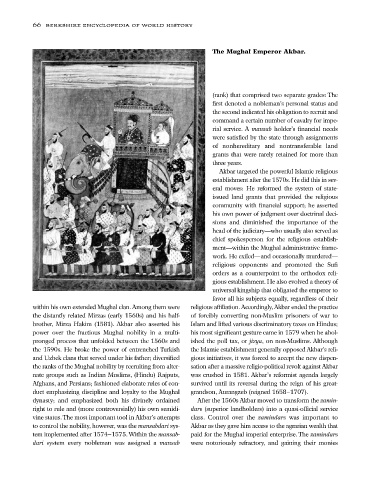
                                                                       The Mughal Emperor Akbar.


                                                                       (rank) that comprised two separate grades: The
                                                                       first denoted a nobleman’s personal status and
                                                                       the second indicated his obligation to recruit and
                                                                       command a certain number of cavalry for impe-
                                                                       rial service. A mansab holder’s financial needs
                                                                       were satisfied by the state through assignments
                                                                       of nonhereditary and nontransferable land
                                                                       grants that were rarely retained for more than
                                                                       three years.
                                                                         Akbar targeted the powerful Islamic religious
                                                                       establishment after the 1570s. He did this in sev-
                                                                       eral moves: He reformed the system of state-
                                                                       issued land grants that provided the religious
                                                                       community with financial support; he asserted
                                                                       his own power of judgment over doctrinal deci-
                                                                       sions and diminished the importance of the
                                                                       head of the judiciary—who usually also served as
                                                                       chief spokesperson for the religious establish-
                                                                       ment—within the Mughal administrative frame-
                                                                       work. He exiled—and occasionally murdered—
                                                                       religious opponents and promoted the Sufi
                                                                       orders as a counterpoint to the orthodox reli-
                                                                       gious establishment. He also evolved a theory of
                                                                       universal kingship that obligated the emperor to
                                                                       favor all his subjects equally, regardless of their
            within his own extended Mughal clan.Among them were  religious affiliation.Accordingly,Akbar ended the practice
            the distantly related Mirzas (early 1560s) and his half-  of forcibly converting non-Muslim prisoners of war to
            brother, Mirza Hakim (1581). Akbar also asserted his  Islam and lifted various discriminatory taxes on Hindus;
            power over the fractious Mughal nobility in a multi-  his most significant gesture came in 1579 when he abol-
            pronged process that unfolded between the 1560s and  ished the poll tax, or jizya, on non-Muslims. Although
            the 1590s. He broke the power of entrenched Turkish  the Islamic establishment generally opposed Akbar’s reli-
            and Uzbek clans that served under his father; diversified  gious initiatives, it was forced to accept the new dispen-
            the ranks of the Mughal nobility by recruiting from alter-  sation after a massive religio-political revolt against Akbar
            nate groups such as Indian Muslims, (Hindu) Rajputs,  was crushed in 1581. Akbar’s reformist agenda largely
            Afghans, and Persians; fashioned elaborate rules of con-  survived until its reversal during the reign of his great-
            duct emphasizing discipline and loyalty to the Mughal  grandson, Aurangzeb (reigned 1658–1707).
            dynasty; and emphasized both his divinely ordained    After the 1560s Akbar moved to transform the zamin-
            right to rule and (more controversially) his own semidi-  dars (superior landholders) into a quasi-official service
            vine status.The most important tool in Akbar’s attempts  class. Control over the  zamindars was important to
            to control the nobility, however, was the mansabdari sys-  Akbar as they gave him access to the agrarian wealth that
            tem implemented after 1574–1575.Within the mansab-  paid for the Mughal imperial enterprise. The zamindars
            dari system every nobleman was assigned a  mansab   were notoriously refractory, and gaining their monies

