


Page 200 - Berkshire Encyclopedia Of World History Vol I - Abraham to Coal
P. 200
american empire 85


                                                    What prudent merchant will hazard his fortunes in any new branch of
                                                    commerce when he knows not that his plans may be rendered unlawful
                                                        before they can be executed? • James Madison (1751–1836)


            this expanded empire silent or ineffective. McCarthyism,  would, in fact, continue to craft the free trade empire that
            named after U.S. Senator Joseph McCarthy, was a polit-  it had begun a century earlier.
            ical attitude characterized by opposition to elements  By the mid-1990s, with a convincing show of military
            held to be subversive and by the use of tactics involving  power in the Middle East and a commitment to global-
            personal attacks.                                   ization in effect, the United States seemed to have the
              By the mid-1960s the United States could wield the  unlimited ability to wage war and gain access to markets.
            power of the dollar and the armed forces to promote its  However, this newly expanded hegemony brought a
            interests virtually everywhere. However, limits to U.S.  new level of criticism with it. Not only human rights
            power began to appear.The United States was unable, for  groups and activists, but also less developed countries
            instance, to remove the Communist government of Fidel  and even sectors of the ruling class began to question the
            Castro in Cuba but, more to the point, found itself  power of transnational corporations and supranational
            increasingly tied down in a growing war in Vietnam,  institutions, such as the WTO and NAFTA, that deter-
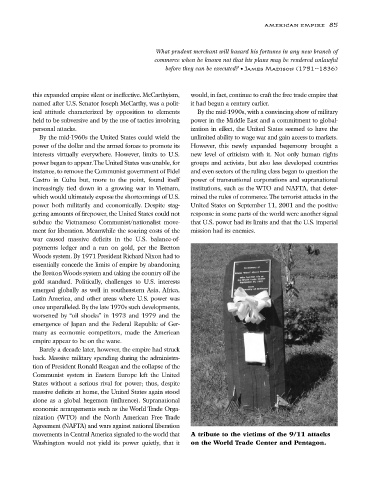
            which would ultimately expose the shortcomings of U.S.  mined the rules of commerce.The terrorist attacks in the
            power both militarily and economically. Despite stag-  United States on September 11, 2001 and the positive
            gering amounts of firepower, the United States could not  response in some parts of the world were another signal
            subdue the Vietnamese Communist/nationalist move-   that U.S. power had its limits and that the U.S. imperial
            ment for liberation. Meanwhile the soaring costs of the  mission had its enemies.
            war caused massive deficits in the U.S. balance-of-
            payments ledger and a run on gold, per the Bretton
            Woods system. By 1971 President Richard Nixon had to
            essentially concede the limits of empire by abandoning
            the Bretton Woods system and taking the country off the
            gold standard. Politically, challenges to U.S. interests
            emerged globally as well in southeastern Asia, Africa,
            Latin America, and other areas where U.S. power was
            once unparalleled. By the late 1970s such developments,
            worsened by “oil shocks” in 1973 and 1979 and the
            emergence of Japan and the Federal Republic of Ger-
            many as economic competitors, made the  American
            empire appear to be on the wane.
              Barely a decade later, however, the empire had struck
            back. Massive military spending during the administra-
            tion of President Ronald Reagan and the collapse of the
            Communist system in Eastern Europe left the United
            States without a serious rival for power; thus, despite
            massive deficits at home, the United States again stood
            alone as a global hegemon (influence). Supranational
            economic arrangements such as the World Trade Orga-
            nization (WTO) and the North  American Free Trade
            Agreement (NAFTA) and wars against national liberation
            movements in Central America signaled to the world that  A tribute to the victims of the 9/11 attacks
            Washington would not yield its power quietly, that it  on the World Trade Center and Pentagon.

