


Page 202 - Berkshire Encyclopedia Of World History Vol I - Abraham to Coal
P. 202
andean states 87


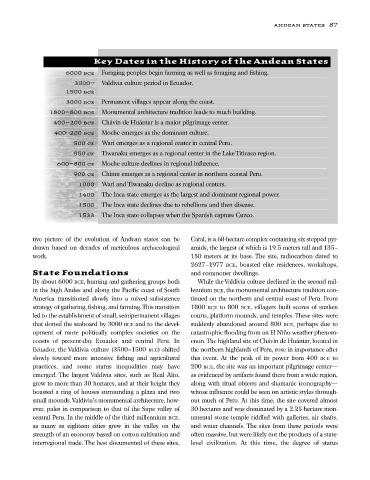
                                Key Dates in the History of the Andean States

                       6000 bce    Foraging peoples begin farming as well as foraging and fishing.
                          3500–    Valdivia culture period in Ecuador.
                       1500 bce
                       3000 bce    Permanent villages appear along the coast.
                 1800–800 bce      Monumental architecture tradition leads to much building.
                   400–200 bce     Chávin de Huántar is a major pilgrimage center.
                   400–200 bce     Moche emerges as the dominant culture.
                         500 ce    Wari emerges as a regional center in central Peru.

                         550 ce    Tiwanaku emerges as a regional center in the Lake Titicaca region.
                    600–800 ce     Moche culture declines in regional influence.
                         900 ce    Chimu emerges as a regional center in northern coastal Peru.
                           1000    Wari and Tiwanaku decline as regional centers.
                           1400    The Inca state emerges as the largest and dominant regional power.
                           1500    The Inca state declines due to rebellions and then disease.
                           1533    The Inca state collapses when the Spanish capture Cuzco.


            tive picture of the evolution of Andean states can be  Caral, is a 68-hectare complex containing six stepped pyr-
            drawn based on decades of meticulous archaeological  amids, the largest of which is 19.5 meters tall and 135–
            work.                                               150 meters at its base. The site, radiocarbon dated to
                                                                2627–1977  BCE, boasted elite residences, workshops,
            State Foundations                                   and commoner dwellings.
            By about 6000 BCE, hunting and gathering groups both  While the Valdivia culture declined in the second mil-
            in the high Andes and along the Pacific coast of South  lennium BCE, the monumental architecture tradition con-
            America transitioned slowly into a mixed subsistence  tinued on the northern and central coast of Peru. From
            strategy of gathering, fishing, and farming.This transition  1800  BCE to 800  BCE, villagers built scores of sunken
            led to the establishment of small, semipermanent villages  courts, platform mounds, and temples. These sites were
            that dotted the seaboard by 3000 BCE and to the devel-  suddenly abandoned around 800 BCE, perhaps due to
            opment of more politically complex societies on the  catastrophic flooding from an El Niño weather phenom-
            coasts of present-day Ecuador and central Peru. In  enon.The highland site of Chávin de Huántar, located in
            Ecuador, the Valdivia culture (3500–1500 BCE) shifted  the northern highlands of Peru, rose in importance after
            slowly toward more intensive  fishing and agricultural  this event. At the peak of its power from 400  BCE to
            practices, and some status inequalities may have    200 BCE, the site was an important pilgrimage center—
            emerged. The largest Valdivia sites, such as Real Alto,  as evidenced by artifacts found there from a wide region,
            grew to more than 30 hectares, and at their height they  along with ritual objects and shamanic iconography—
            boasted a ring of houses surrounding a plaza and two  whose influence could be seen on artistic styles through-
            small mounds.Valdivia’s monumental architecture, how-  out much of Peru. At this time, the site covered almost
            ever, pales in comparison to that of the Supe valley of  30 hectares and was dominated by a 2.25-hectare mon-
            central Peru. In the middle of the third millennium BCE,  umental stone temple riddled with galleries, air shafts,
            as many as eighteen cities grew in the valley on the  and water channels. The sites from these periods were
            strength of an economy based on cotton cultivation and  often massive, but were likely not the products of a state-
            interregional trade. The best documented of these sites,  level civilization. At this time, the degree of status

