


Page 240 - Berkshire Encyclopedia Of World History Vol I - Abraham to Coal
P. 240
art—ancient greece and rome 125


            erence served as an elevating agent of monumentality in  later took the name LuciusTarquinius Priscus and became
            earlier Greek art, reference to, or even quotation of, the  the first Etruscan king of Rome. On the heights of the
            buildings and sculpture of the Periclean  Acropolis  Capitoline Hill in Rome, the central peak and religious
            became a common agent of monumentality in the official  center of Etruscan and Latin Rome, Tarquinius initiated
            art and architecture of the Hellenistic kingdoms of  the construction of the  first monumental temple in
            Greece, particularly of Pergamon.                   Rome, dedicated to Jupiter, Juno, and Minerva, the same
                                                                three divinities who in their Greek guise of Zeus, Hera,
            Corinth and the Etruscans:                          and Athena dominated the central height and religious
            Greek Influence on Rome                             center of Corinth. This cult of the Capitoline Triad
            The connections between Greece and Rome are almost  became the central cult of the Roman republic and
            as old as the cultures themselves, and the origins of mon-  empire, and the triple-chambered plan of their temple,
            umental temple architecture in Rome were traced by the  completed after the Etruscans were expelled from Rome
            Romans themselves back to mid-seventh-century       at the end of the sixth century BCE, formed the template
            Corinth.Around the time the Corinthians were designing  for all subsequent Capitolia.
            and building the  first truly monumental temple in     From the Etruscans the Romans inherited the tradition
            Greece, the old ruling oligarchy was overthrown and  of monumental wood and terra-cotta temple architecture.
            expelled from Corinth. When one of the deposed oli-  They were also deeply influenced by Etruscan sculpture,
            garchs, Damaratus, fled by ship from Corinth he carried  painting, and religious and political institutions.The tra-
            with him a host of artisans, including terra-cotta workers,  dition of Roman portraiture, a paradigmatic manifesta-
            craftsmen we now know were most responsible for the  tion of an innate Roman fascination with the literal
            monumental character of that temple—through their      details of history, finds its roots in Etruscan funerary
            invention of the tiled roof. Damaratus                          sculpture that goes back to the seventh
            sailed with them to the west coast of                               century BCE.As much as any other art
            Italy and settled in the Etruscan                                       form, the super-realistic, warts-
            town of  Tarquinia, where                                                 and-all portraiture of republi-
            Damaratus’s artisans intro-                                                 can Rome (509–27  BCE)
            duced the Etruscans—who                                                       embodies the traditional
            became the greatest terra-                                                     Roman dedication to his-
            cotta sculptors of the                                                          tory, family, and age-old
            Mediterranean—to the                                                            values. And as much as
            art of molding terra-                                                           any other art form, the
            cotta. So, in addition to                                                        conception and appear-
            developing the first tra-                                                        ance of Roman republi-
            dition of monumental                                                            can portraiture stands
            architecture in Greece,                                                        in opposition to the tra-
            Corinth was also a crucial                                                     ditional Greek concep-
            source for the origins of                                                    tion of monumental art.
            monumental sculpture and                                                    Through generalization and
            architecture in Etruria. Damara-
            tus then extended Corinth’s artistic
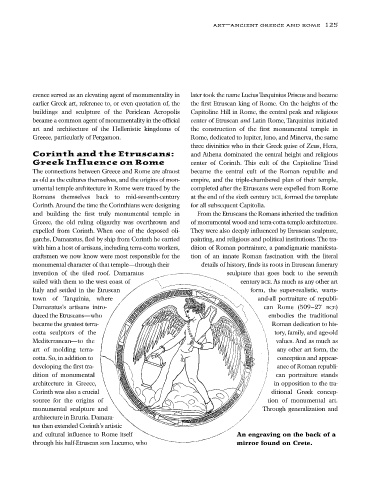
            and cultural influence to Rome itself                               An engraving on the back of a
            through his half-Etruscan son Lucumo, who                          mirror found on Crete.

