


Page 238 - Berkshire Encyclopedia Of World History Vol I - Abraham to Coal
P. 238
art—ancient greece and rome 123


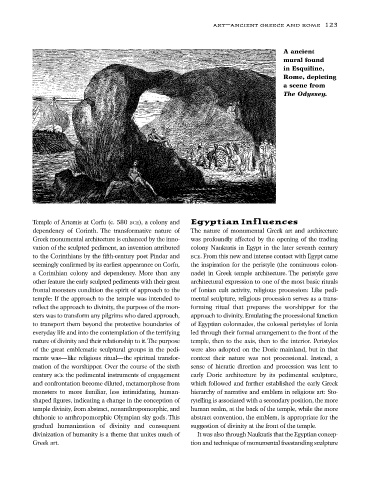
                                                                                               A ancient
                                                                                               mural found
                                                                                               in Esquiline,
                                                                                               Rome, depicting
                                                                                               a scene from
                                                                                               The Odyssey.


            Temple of Artemis at Corfu (c. 580 BCE), a colony and  Egyptian Influences
            dependency of Corinth. The transformative nature of  The nature of monumental Greek art and architecture
            Greek monumental architecture is enhanced by the inno-  was profoundly affected by the opening of the trading
            vation of the sculpted pediment, an invention attributed  colony Naukratis in Egypt in the later seventh century
            to the Corinthians by the fifth-century poet Pindar and  BCE. From this new and intense contact with Egypt came
            seemingly confirmed by its earliest appearance on Corfu,  the inspiration for the peristyle (the continuous colon-
            a Corinthian colony and dependency. More than any   nade) in Greek temple architecture. The peristyle gave
            other feature the early sculpted pediments with their great  architectural expression to one of the most basic rituals
            frontal monsters condition the spirit of approach to the  of Ionian cult activity, religious procession: Like pedi-
            temple: If the approach to the temple was intended to  mental sculpture, religious procession serves as a trans-
            reflect the approach to divinity, the purpose of the mon-  forming ritual that prepares the worshipper for the
            sters was to transform any pilgrims who dared approach,  approach to divinity. Emulating the processional function
            to transport them beyond the protective boundaries of  of Egyptian colonnades, the colossal peristyles of Ionia
            everyday life and into the contemplation of the terrifying  led through their formal arrangement to the front of the
            nature of divinity and their relationship to it.The purpose  temple, then to the axis, then to the interior. Peristyles
            of the great emblematic sculptural groups in the pedi-  were also adopted on the Doric mainland, but in that
            ments was—like religious ritual—the spiritual transfor-  context their nature was not processional. Instead, a
            mation of the worshipper. Over the course of the sixth  sense of hieratic direction and procession was lent to
            century BCE the pedimental instruments of engagement  early Doric architecture by its pedimental sculpture,
            and confrontation become diluted, metamorphose from  which followed and further established the early Greek
            monsters to more familiar, less intimidating, human-  hierarchy of narrative and emblem in religious art: Sto-
            shaped figures, indicating a change in the conception of  rytelling is associated with a secondary position, the more
            temple divinity, from abstract, nonanthropomorphic, and  human realm, at the back of the temple, while the more
            chthonic to anthropomorphic Olympian sky gods. This  abstract convention, the emblem, is appropriate for the
            gradual humanization of divinity and consequent     suggestion of divinity at the front of the temple.
            divinization of humanity is a theme that unites much of  It was also through Naukratis that the Egyptian concep-
            Greek art.                                          tion and technique of monumental freestanding sculpture

