


Page 234 - Berkshire Encyclopedia Of World History Vol I - Abraham to Coal
P. 234
art—africa 119


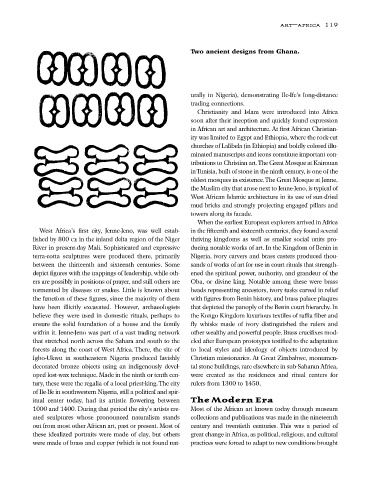
                                                                Two ancient designs from Ghana.


                                                                urally in Nigeria), demonstrating Ile-Ife’s long-distance
                                                                trading connections.
                                                                  Christianity and Islam were introduced into Africa
                                                                soon after their inception and quickly found expression
                                                                in African art and architecture. At first African Christian-
                                                                ity was limited to Egypt and Ethiopia, where the rock-cut
                                                                churches of Lalibela (in Ethiopia) and boldly colored illu-
                                                                minated manuscripts and icons constitute important con-
                                                                tributions to Christian art.The Great Mosque at Kairouan
                                                                inTunisia, built of stone in the ninth century, is one of the
                                                                oldest mosques in existence.The Great Mosque at Jenne,
                                                                the Muslim city that arose next to Jenne-Jeno, is typical of
                                                                West African Islamic architecture in its use of sun-dried
                                                                mud bricks and strongly projecting engaged pillars and
                                                                towers along its facade.
                                                                  When the earliest European explorers arrived in Africa
              West Africa’s first city, Jenne-Jeno, was well estab-  in the fifteenth and sixteenth centuries, they found several
            lished by 800 CE in the inland delta region of the Niger  thriving kingdoms as well as smaller social units pro-
            River in present-day Mali. Sophisticated and expressive  ducing notable works of art. In the Kingdom of Benin in
            terra-cotta sculptures were produced there, primarily  Nigeria, ivory carvers and brass casters produced thou-
            between the thirteenth and sixteenth centuries. Some  sands of works of art for use in court rituals that strength-
            depict figures with the trappings of leadership, while oth-  ened the spiritual power, authority, and grandeur of the
            ers are possibly in positions of prayer, and still others are  Oba, or divine king. Notable among these were brass
            tormented by diseases or snakes. Little is known about  heads representing ancestors, ivory tusks carved in relief
            the function of these figures, since the majority of them  with figures from Benin history, and brass palace plaques
            have been illicitly excavated. However, archaeologists  that depicted the panoply of the Benin court hierarchy. In
            believe they were used in domestic rituals, perhaps to  the Kongo Kingdom luxurious textiles of raffia fiber and
            ensure the solid foundation of a house and the family  fly whisks made of ivory distinguished the rulers and
            within it. Jenne-Jeno was part of a vast trading network  other wealthy and powerful people. Brass crucifixes mod-
            that stretched north across the Sahara and south to the  eled after European prototypes testified to the adaptation
            forests along the coast of West Africa. There, the site of  to local styles and ideology of objects introduced by
            Igbo-Ukwu in southeastern Nigeria produced lavishly  Christian missionaries. At Great Zimbabwe, monumen-
            decorated bronze objects using an indigenously devel-  tal stone buildings, rare elsewhere in sub-Saharan Africa,
            oped lost-wax technique. Made in the ninth or tenth cen-  were created as the residences and ritual centers for
            tury, these were the regalia of a local priest-king.The city  rulers from 1300 to 1450.
            of Ile-Ife in southwestern Nigeria, still a political and spir-
            itual center today, had its artistic flowering between  The Modern Era
            1000 and 1400. During that period the city’s artists cre-  Most of the African art known today through museum
            ated sculptures whose pronounced naturalism stands  collections and publications was made in the nineteenth
            out from most other African art, past or present. Most of  century and twentieth centuries. This was a period of
            these idealized portraits were made of clay, but others  great change in Africa, as political, religious, and cultural
            were made of brass and copper (which is not found nat-  practices were forced to adapt to new conditions brought

