


Page 229 - Berkshire Encyclopedia Of World History Vol I - Abraham to Coal
P. 229
114 berkshire encyclopedia of world history


            accretions. French architect Jacques-Germain Soufflot  Early Modernism
            combined Gothic structural lightness with classical spa-  In the nineteenth century, the Industrial Revolution
            tial purity in his Church of Ste.-Geneviève (1755–1780)  expanded its impact on European architecture. France’s
            in Paris. Étienne-Louis Boullée drew unbuildable projects,  official architectural school, the  École des Beaux-Arts,
            like the Cenotaph to Isaac Newton (1783–1784), a clas-  emphasized “universal” architectural ideals found in pri-
            sical but sublime giant hollow sphere that celebrated the  marily classical models, but the buildings of its alumni,
            achievements of the great physicist. It connected use and  including Charles Garnier’s exuberant Opéra (1860–
            form in a direct manner called “architecture parlante.”  1875) and Henri Labrouste’s Bibliothèque Ste.-
            Mining historical styles for contemporary projects con-  Geneviéve (1838–1850), both in Paris, united those les-
            tinued into the nineteenth century, highlighted by Karl  sons with contemporary technology. The celebration of
            Friedrich Schinkel’s Greek Revival Altes Museum (1824–  modern materials and their logical assembly was epito-
            1830) in Berlin, and the Gothic Revival Houses of Par-  mized by the Eiffel Tower (1887–1889), by Gustave Eif-
            liament (begun 1835) in London, by Charles Barry and  fel. Conversely, William Morris, the most significant
            A.W. N. Pugin.                                      British voice at the time, protested against the social
              By the mid-eighteenth century, Europeans began to  upheaval and shoddy craftsmanship associated with the
            seek increasingly private and comfortable residences.  Industrial Revolution. His Arts and Crafts Movement was
            Renovated (1732–1739) in the delicate Rococo style by  advertised by his own home, The Red House (1859–
            Germain Boffrand, the Hôtel de Soubise in Paris incor-  1860), by Philip Webb, in Bexley Heath, with its infor-
            porated intimate interiors that were easily heated by  mal, vernacularly derived forms and materials that hear-
            improved fireplace design and easily illuminated by large  kened back to a simpler time.
            windows and mirrors. Residences of the well-to-do incor-  American architects adapted these British ideas to
            porated dumbwaiters and corridors to allow
            greater separation between masters and
            their servants. The English aris-
            tocracy and North  American
            colonists also turned to making
            more comfortable buildings,
            typically favoring a restrained
            neo-Palladian approach to de-
            sign, such as  Thomas Jeffer-
            son’s Monticello (1768–1782)
            in Charlottesville,Virginia.


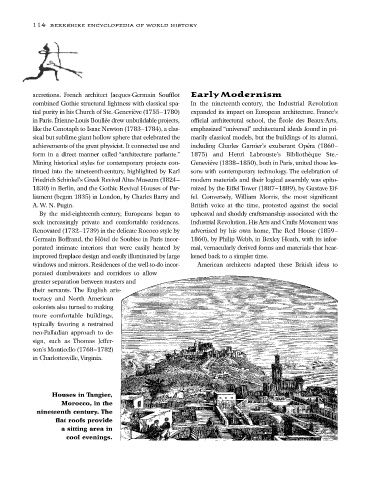
                  Houses in Tangier,
                     Morocco, in the
             nineteenth century. The
                   flat roofs provide
                     a sitting area in
                       cool evenings.

