


Page 227 - Berkshire Encyclopedia Of World History Vol I - Abraham to Coal
P. 227
112 berkshire encyclopedia of world history


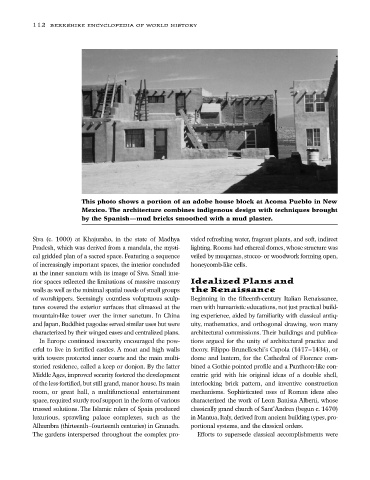
                            This photo shows a portion of an adobe house block at Acoma Pueblo in New
                            Mexico. The architecture combines indigenous design with techniques brought
                            by the Spanish—mud bricks smoothed with a mud plaster.


            Siva (c. 1000) at Khajuraho, in the state of Madhya  vided refreshing water, fragrant plants, and soft, indirect
            Pradesh, which was derived from a mandala, the mysti-  lighting. Rooms had ethereal domes, whose structure was
            cal gridded plan of a sacred space. Featuring a sequence  veiled by muqarnas, stucco- or woodwork forming open,
            of increasingly important spaces, the interior concluded  honeycomb-like cells.
            at the inner sanctum with its image of Siva. Small inte-
            rior spaces reflected the limitations of massive masonry  Idealized Plans and
            walls as well as the minimal spatial needs of small groups  the Renaissance
            of worshippers. Seemingly countless voluptuous sculp-  Beginning in the fifteenth-century Italian Renaissance,
            tures covered the exterior surfaces that climaxed at the  men with humanistic educations, not just practical build-
            mountain-like tower over the inner sanctum. In China  ing experience, aided by familiarity with classical antiq-
            and Japan, Buddhist pagodas served similar uses but were  uity, mathematics, and orthogonal drawing, won many
            characterized by their winged eaves and centralized plans.  architectural commissions. Their buildings and publica-
              In Europe continued insecurity encouraged the pow-  tions argued for the unity of architectural practice and
            erful to live in fortified castles. A moat and high walls  theory. Filippo Brunelleschi’s Cupola (1417–1434), or
            with towers protected inner courts and the main multi-  dome and lantern, for the Cathedral of Florence com-
            storied residence, called a keep or donjon. By the latter  bined a Gothic pointed profile and a Pantheon-like con-
            Middle Ages, improved security fostered the development  centric grid with his original ideas of a double shell,
            of the less-fortified, but still grand, manor house. Its main  interlocking brick pattern, and inventive construction
            room, or great hall, a multifunctional entertainment  mechanisms. Sophisticated uses of Roman ideas also
            space, required sturdy roof support in the form of various  characterized the work of Leon Battista Alberti, whose
            trussed solutions. The Islamic rulers of Spain produced  classically grand church of Sant’Andrea (begun c. 1470)
            luxurious, sprawling palace complexes, such as the  in Mantua, Italy, derived from ancient building types, pro-
            Alhambra (thirteenth–fourteenth centuries) in Granada.  portional systems, and the classical orders.
            The gardens interspersed throughout the complex pro-  Efforts to supersede classical accomplishments were

