


Page 225 - Berkshire Encyclopedia Of World History Vol I - Abraham to Coal
P. 225
110 berkshire encyclopedia of world history


                                                                The Greek Temple
                                                                The ancient Greeks influenced later Western builders with
                                                                their post-and-lintel building tradition. Their three types
                                                                of orders— systems of columns supporting entablatures
                                                                —were distinguished by proportion and decoration.
                                                                Stone blocks of limestone and marble were held in place
                                                                by metal clamps and dowels, and the sloping wooden
                                                                roof rafters were covered by terra-cotta tiles.The apex of
                                                                Greek architecture, the Parthenon temple (448 BCE–32
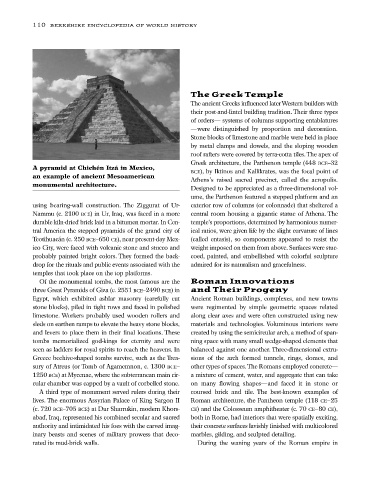
            A pyramid at Chichén Itzá in Mexico,
                                                                BCE), by Iktinos and Kallikrates, was the focal point of
            an example of ancient Mesoamerican
                                                                Athens’s raised sacred precinct, called the acropolis.
            monumental architecture.
                                                                Designed to be appreciated as a three-dimensional vol-
                                                                ume, the Parthenon featured a stepped platform and an
            using bearing-wall construction. The Ziggurat of Ur-  exterior row of columns (or colonnade) that sheltered a
            Nammu (c. 2100 BCE) in Ur, Iraq, was faced in a more  central room housing a gigantic statue of Athena. The
            durable kiln-dried brick laid in a bitumen mortar. In Cen-  temple’s proportions, determined by harmonious numer-
            tral America the stepped pyramids of the grand city of  ical ratios, were given life by the slight curvature of lines
            Teotihuacán (c. 250 BCE–650 CE), near present-day Mex-  (called entasis), so components appeared to resist the
            ico City, were faced with volcanic stone and stucco and  weight imposed on them from above. Surfaces were stuc-
            probably painted bright colors. They formed the back-  coed, painted, and embellished with colorful sculpture
            drop for the rituals and public events associated with the  admired for its naturalism and gracefulness.
            temples that took place on the top platforms.
              Of the monumental tombs, the most famous are the  Roman Innovations
            three Great Pyramids of Giza (c. 2551 BCE–2490 BCE) in  and Their Progeny
            Egypt, which exhibited ashlar masonry (carefully cut  Ancient Roman buildings, complexes, and new towns
            stone blocks), piled in tight rows and faced in polished  were regimented by simple geometric spaces related
            limestone. Workers probably used wooden rollers and  along clear axes and were often constructed using new
            sleds on earthen ramps to elevate the heavy stone blocks,  materials and technologies. Voluminous interiors were
            and levers to place them in their final locations. These  created by using the semicircular arch, a method of span-
            tombs memorialized god-kings for eternity and were  ning space with many small wedge-shaped elements that
            seen as ladders for royal spirits to reach the heavens. In  balanced against one another. Three-dimensional extru-
            Greece beehive-shaped tombs survive, such as the Trea-  sions of the arch formed tunnels, rings, domes, and
            sury of Atreus (or Tomb of Agamemnon, c. 1300 BCE–  other types of spaces.The Romans employed concrete—
            1250 BCE) at Mycenae, where the subterranean main cir-  a mixture of cement, water, and aggregate that can take
            cular chamber was capped by a vault of corbelled stone.  on many  flowing shapes—and faced it in stone or
              A third type of monument served rulers during their  coursed brick and tile. The best-known examples of
            lives. The enormous Assyrian Palace of King Sargon II  Roman architecture, the Pantheon temple (118 CE–25
            (c. 720 BCE–705 BCE) at Dur Sharrukin, modern Khors-  CE) and the Colosseum amphitheater (c. 70 CE–80 CE),
            abad, Iraq, represented his combined secular and sacred  both in Rome, had interiors that were spatially exciting,
            authority and intimidated his foes with the carved imag-  their concrete surfaces lavishly finished with multicolored
            inary beasts and scenes of military prowess that deco-  marbles, gilding, and sculpted detailing.
            rated its mud-brick walls.                            During the waning years of the Roman empire in

